God Bless,
Showing posts with label Little Dorrit. Show all posts
Friday, January 20, 2012
Are These Songs the Same Song? (Little Dorrit, Downton Abbey)
Comments are very much appreciated! This has bothered me for months ever since I first watched Downton Abbey. I remembered when I first watched Downton Abbey: my mom and I were on the second episode and this song came on...
The first thing I thought was "Hey! That song is in Little Dorrit!" I could have sworn that it was the same song!
Watch from 0:00 to 0:44
I am asking for your opinion: are these two songs the same? They seem to have the same melody and the same musical instruments. Comments are welcome!
God Bless,
God Bless,
Thursday, September 29, 2011
Lists: Top 10 Favorite Heroes
Due to the great response to my "Top 10 Favorite Heroines" post, I put together my Top 10 Favorite Heroes! Enjoy!
Probably a very obvious answer from me! I didn't always like Mr. Darcy (c'mon, he was a bit of a jerk at the beginning of Pride and Prejudice), but after a while he grew on me once his character improved, and now he's my favorite hero! Yes, he was a bit arrogant at the beginning of Pride and Prejudice, but his arrogance decreases as the plot progresses; he's also a good brother and takes it upon himself to bring about the marriage of Lydia and Wickham after their scandal.
To me, Colin Firth is Mr. Darcy, period. He has the look of arrogance in the beginning, but then as Pride and Prejudice goes on, he has that more of a caring look. He also did all of Mr. Darcy subtle looks really well.
While reading/watching Sense and Sensibility, how can you not feel sorry for Colonel Brandon? All the stuff that he had to go through and yet he doesn't complain about it. As much as I like Marianne Dashwood, I still thought she was really mean about Colonel Brandon (Willoughby made fun of him and she went along with it). He was able to act like a gentleman while Willoughby was apart of the party.
3. George Knightley (Emma)
Oh, Mr. Knightley. He tries to help Emma by telling her that she is wrong, but she doesn't listen (well, most of the time). Mr. Knightley is very caring, a great brother-in-law to Emma, a great uncle to John and Isabella's children, and (we can be sure) a great husband for Emma. He helps out his neighbors whenever he can (sending Mrs. and Miss Bates food, saving Harriet during the dance when Mr. Elton snubbed her, etc.). Overall, Mr. Knightley is a great guy and a gentleman!
Johnny Lee Miller is my favorite Mr. Knightley. I did also like Jeremy Northam's Mr. Knightley, but I think Johnny Lee Miller's was closer to the Mr. Knightley in the book... at least to my memory.
When you first see Mr. Tilney in Northanger Abbey, you might find him a little odd (I know I did), but in a good way. When you get to know him more, you can see that he likes to tease his sister Eleanor and Catherine a little bit in a friendly way. Once you know more about him, you can see that he's a caring brother and a great husband for Catherine.
5. Arthur Clennam (Little Dorrit)
I like how Mr. Clennam tries to help out the Dorrits: he's trying to right a wrong that he thinks his family business may have done, and how many people would go through the trouble of finding out who they wronged? Plus, when he loses all his money and is in debt, he doesn't run away from his obligations, but faces them and is accountable for them. He messed up and took the consequences of it. In this world where people tend to run away from their responsibilities and obligations, Arthur Clennam is a good example of what people should do: accept responsibility and face the consequences of your actions.
I've seen both the new and older version of Little Dorrit, and I think Matthew McFayden's Arthur Clennam is the better one. His was much better acted than Derek Jacobi's Arthur Clennam, plus Derek Jacobi was just too old.
7. Septimas Harding (The Barchester Chronicles)
Mr. Harding was such a sweet old man! I felt sorry that in the first part of The Barchester Chronicles that Mr. Bold was going to sue him because of his salary. He was almost instantly likable, which is what you need in a series/miniseries/movie/etc. in order for people to like it. And, considering The Barchester Chronicles is an 80s miniseries, the acting has to be very good since there aren't the effects that newer period dramas have. Donald Pleasance played Mr. Harding very well. I'll definitely have to watch The Barchester Chronicles again to see what I've missed.
I've got three heroes from Downton Abbey that I like, but couldn't choose in what order. Robert is a great master of Downton. He cares for all of his employees and the surrounding area. He doesn't mope around about the entail, but instead teaches the way to run Downton to his third cousin and heir of Downton, Matthew Crawley. He also tries to be a good father to his three children and a good husband to Cora.
8/9/10 (Tied). John Bates (Downton Abbey)
Poor Mr. Bates... He arrives at Downton with a limp and most of the staff thinks he can't do his job... But he persists at his job and he gains everyone's respect (well except for a few). He's almost in an Edward Ferrars position except he's actually married instead of engaged: he loves Anna, one of the maids, but he remembers his duty to his wife. He tries to do the honorable thing while at Downton. I wonder what will happen with him in Season 2 (I'm hoping they don't ruin his character like what sometimes happens when series go on).
John Bates is played by Brenden Coyle. I first saw Brenden Coyle in Lark Rise to Candleford as Laura Timmins's father, Robert. I must say that I like John Bates better than Robert Timmins: Robert became too much of a jerk after awhile.
At first, you have to warm up to Matthew a little bit since he tries so hard not to change (and since the Crawleys at Downton Abbey are one of the first characters we've seen, it might be a little easier to side with them). But then when Matthew gets settled in near Downton, he really tries hard to learn how to run the estate. He takes an interest in fixing up the cottages in the surrounding area and as Robert's family likes him more and more, we start to like him more and more.
I will say that I started to read Mansfield Park a little while ago and Edmund Bertram looks promising. Maybe he might bump someone off the list in the future? But as for now, this is the list of my top favorite heroes!
What do you think of my list? Are there some heroes in my list that you would include in your top favorite heroes? Who would you include in your list? Leave a comment!
God Bless,
Probably a very obvious answer from me! I didn't always like Mr. Darcy (c'mon, he was a bit of a jerk at the beginning of Pride and Prejudice), but after a while he grew on me once his character improved, and now he's my favorite hero! Yes, he was a bit arrogant at the beginning of Pride and Prejudice, but his arrogance decreases as the plot progresses; he's also a good brother and takes it upon himself to bring about the marriage of Lydia and Wickham after their scandal.To me, Colin Firth is Mr. Darcy, period. He has the look of arrogance in the beginning, but then as Pride and Prejudice goes on, he has that more of a caring look. He also did all of Mr. Darcy subtle looks really well.
2. Colonel Brandon (Sense and Sensibility)
While reading/watching Sense and Sensibility, how can you not feel sorry for Colonel Brandon? All the stuff that he had to go through and yet he doesn't complain about it. As much as I like Marianne Dashwood, I still thought she was really mean about Colonel Brandon (Willoughby made fun of him and she went along with it). He was able to act like a gentleman while Willoughby was apart of the party. I did like David Morrissey's Colonel Brandon, but it seemed like something was missing for him in the 2008 Sense and Sensibility. To me, Alan Rickman did a better job in the 1995 movie.
3. George Knightley (Emma)
Oh, Mr. Knightley. He tries to help Emma by telling her that she is wrong, but she doesn't listen (well, most of the time). Mr. Knightley is very caring, a great brother-in-law to Emma, a great uncle to John and Isabella's children, and (we can be sure) a great husband for Emma. He helps out his neighbors whenever he can (sending Mrs. and Miss Bates food, saving Harriet during the dance when Mr. Elton snubbed her, etc.). Overall, Mr. Knightley is a great guy and a gentleman!Johnny Lee Miller is my favorite Mr. Knightley. I did also like Jeremy Northam's Mr. Knightley, but I think Johnny Lee Miller's was closer to the Mr. Knightley in the book... at least to my memory.
4. Henry Tilney (Northanger Abbey)
When you first see Mr. Tilney in Northanger Abbey, you might find him a little odd (I know I did), but in a good way. When you get to know him more, you can see that he likes to tease his sister Eleanor and Catherine a little bit in a friendly way. Once you know more about him, you can see that he's a caring brother and a great husband for Catherine.I've only seen the 2007 version of Northanger Abbey (unless the Wishbone episode counts), and despite the problems it had with the screenplay, the actors were well cast. J.J. Field's Mr. Tilney was very well done.
5. Arthur Clennam (Little Dorrit)
I like how Mr. Clennam tries to help out the Dorrits: he's trying to right a wrong that he thinks his family business may have done, and how many people would go through the trouble of finding out who they wronged? Plus, when he loses all his money and is in debt, he doesn't run away from his obligations, but faces them and is accountable for them. He messed up and took the consequences of it. In this world where people tend to run away from their responsibilities and obligations, Arthur Clennam is a good example of what people should do: accept responsibility and face the consequences of your actions.I've seen both the new and older version of Little Dorrit, and I think Matthew McFayden's Arthur Clennam is the better one. His was much better acted than Derek Jacobi's Arthur Clennam, plus Derek Jacobi was just too old.
I don't like that Edward had Elinor like him when he wasn't supposed to, but I will say that he does do the honorable thing by staying engaged to Lucy even though he doesn't love Lucy anymore, but instead loves Elinor. He sticks to his duty even when it becomes very hard.
I prefer Dan Stevens's Edward to Hugh Grant's. Hugh Grant just looked too sickly for the role.
7. Septimas Harding (The Barchester Chronicles)
Mr. Harding was such a sweet old man! I felt sorry that in the first part of The Barchester Chronicles that Mr. Bold was going to sue him because of his salary. He was almost instantly likable, which is what you need in a series/miniseries/movie/etc. in order for people to like it. And, considering The Barchester Chronicles is an 80s miniseries, the acting has to be very good since there aren't the effects that newer period dramas have. Donald Pleasance played Mr. Harding very well. I'll definitely have to watch The Barchester Chronicles again to see what I've missed.8/9/10 (Tied). Robert Crawley, Lord of Grantham (Downton Abbey)
I've got three heroes from Downton Abbey that I like, but couldn't choose in what order. Robert is a great master of Downton. He cares for all of his employees and the surrounding area. He doesn't mope around about the entail, but instead teaches the way to run Downton to his third cousin and heir of Downton, Matthew Crawley. He also tries to be a good father to his three children and a good husband to Cora.Hugh Bonneville played Robert in Downton Abbey. Hugh Bonneville does a very good job acting here. I can't wait to see what's in store for Robert in Series 2
8/9/10 (Tied). John Bates (Downton Abbey)
Poor Mr. Bates... He arrives at Downton with a limp and most of the staff thinks he can't do his job... But he persists at his job and he gains everyone's respect (well except for a few). He's almost in an Edward Ferrars position except he's actually married instead of engaged: he loves Anna, one of the maids, but he remembers his duty to his wife. He tries to do the honorable thing while at Downton. I wonder what will happen with him in Season 2 (I'm hoping they don't ruin his character like what sometimes happens when series go on).John Bates is played by Brenden Coyle. I first saw Brenden Coyle in Lark Rise to Candleford as Laura Timmins's father, Robert. I must say that I like John Bates better than Robert Timmins: Robert became too much of a jerk after awhile.
8/9/10 (Tied). Matthew Crawley (Downton Abbey)
At first, you have to warm up to Matthew a little bit since he tries so hard not to change (and since the Crawleys at Downton Abbey are one of the first characters we've seen, it might be a little easier to side with them). But then when Matthew gets settled in near Downton, he really tries hard to learn how to run the estate. He takes an interest in fixing up the cottages in the surrounding area and as Robert's family likes him more and more, we start to like him more and more.Dan Stevens, who also played Edward Ferrars in the 2008 Sense and Sensibility, plays Matthew Crawley in Downton Abbey.
I will say that I started to read Mansfield Park a little while ago and Edmund Bertram looks promising. Maybe he might bump someone off the list in the future? But as for now, this is the list of my top favorite heroes!
What do you think of my list? Are there some heroes in my list that you would include in your top favorite heroes? Who would you include in your list? Leave a comment!
God Bless,
Tuesday, September 20, 2011
Oh no! The Period Drama I'm Watching Has Inaccurate Costuming!
If you're like me, one of the first things I notice in a period drama is the costuming. I love looking at the costumes and, since I like studying historical fashion, I try to pick out the era in which the story is taking place just by looking at the clothing.
But then it happens: you're watching a period drama and the clothing does not match up to the time period! Oh no!
Don't worry just yet -- there may be a chance that the period drama that you are viewing might not be as inaccurate as it seems. There are a couple of ways that characters can get away with using older fashions than the period the film is taking place. Note: These are just my observations and assumptions. I may have also read a little about this topic and can't place the exact source.
1. The character is an older/elderly character
The younger characters will want the latest fashions: they've never seen anything like it before -- they love the latest fashions -- they need them! However, if a character is older, chances are they like the fashions that they have and will therefore wear them instead of the current fashions.
2. The character is poor
Obviously, if a character does not have a lot of money, money will mostly go to the absolute necessities and not on the latest fashions. Chances are, they clothes that the poorer characters would wear would most likely be hand-me-downs.
3. The character does not go out into society
There are a couple of characters in period dramas that never leave their house. Since they don't leave their homes, they don't need to get the latest fashions since no one (or few) will see them. They also may not be physically able to go to a store to look at the latest fashions and buy them.
God Bless,
But then it happens: you're watching a period drama and the clothing does not match up to the time period! Oh no!
Don't worry just yet -- there may be a chance that the period drama that you are viewing might not be as inaccurate as it seems. There are a couple of ways that characters can get away with using older fashions than the period the film is taking place. Note: These are just my observations and assumptions. I may have also read a little about this topic and can't place the exact source.
1. The character is an older/elderly character
The younger characters will want the latest fashions: they've never seen anything like it before -- they love the latest fashions -- they need them! However, if a character is older, chances are they like the fashions that they have and will therefore wear them instead of the current fashions.
Example
Mrs. Jennings (Sense and Sensibility)
Time Period of Story: 1795 - 1820
Time Period of Fashion: 1780-1790s
I hesitated putting up Mrs. Jennings since she is a rich character (see #2), and does go out into society (see #4), which would make it seem like she would have the latest fashions, but you could make an argument that her dresses/hairstyle may be accurate. It's possible that she liked the Georgian Fashions of her youth better than the Regency Fashions and decided to stick to the Georgian Fashions. Although, they do make an attempt to give her a Regency waistline on her dress, the lace along the neckline looks Georgian, but her hair is definitely Georgian.
2. The character is poor
Obviously, if a character does not have a lot of money, money will mostly go to the absolute necessities and not on the latest fashions. Chances are, they clothes that the poorer characters would wear would most likely be hand-me-downs.
Fanny Dorrit (Little Dorrit - 2008)
Time Period of Story: 1826
Time Period of Fashion: 1805 - 1820
Here, I'm mostly talking about Fanny during the first half of Little Dorrit. Fanny would possibly have gotten some hand-me-downs from the Regency Era that was once her mother's, and since the Dorrits were poor, she probably could not get newer clothes on her own. Little Dorrit takes place in about 1826; the Regency Era ended in 1820: from 1820 to 1830 the waistlines of the dresses began to descend until they hit the natural waist where they would remain for quite some time.
3. The character does not go out into society
There are a couple of characters in period dramas that never leave their house. Since they don't leave their homes, they don't need to get the latest fashions since no one (or few) will see them. They also may not be physically able to go to a store to look at the latest fashions and buy them.
Examples
Mrs. Clennam (Little Dorrit - 2008)
Time Period of Story: 1826
Miss Havisham (Great Expectations - 1999)
Time Period of Story: 1850s?
Time Period of Fashion: 1795 - 1820, possibly 1805 - 1820
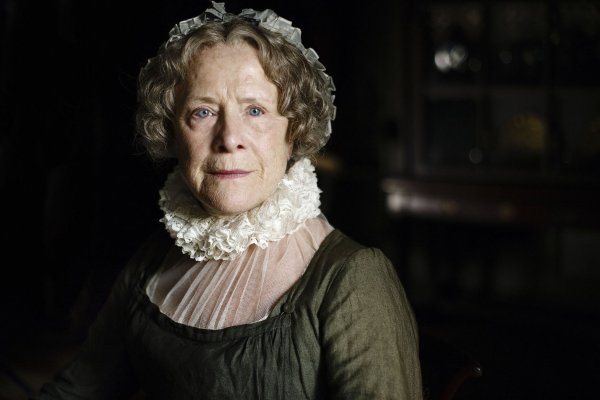
Both characters are confined to the house they live in, but for different reasons. Mrs. Clennam cannot leave her house because she is an invalid and bound to a wheelchair. Miss Havisham's reason is that she had her heart broken on her wedding day and imposes solitude on herself. While Mrs. Clennam's confinement is physical and Miss Havisham's is emotional, either way both do not get out into society and therefore both do not really need newer clothes. You could also say that they're both older characters which could also be why they have older clothes (see #2).
4. The character does not live in/near town
If you're nearest to the big cities, you usually get your hands on the latest fashions right away. But out in the country and in a time when communication was much slower than it is today, it may take a little while for the latest fashions to appear. Unfortunately, I can't come up with a really good example of this, but it was something that occurred to me as a possibility of a character not having period clothing.
Both characters are confined to the house they live in, but for different reasons. Mrs. Clennam cannot leave her house because she is an invalid and bound to a wheelchair. Miss Havisham's reason is that she had her heart broken on her wedding day and imposes solitude on herself. While Mrs. Clennam's confinement is physical and Miss Havisham's is emotional, either way both do not get out into society and therefore both do not really need newer clothes. You could also say that they're both older characters which could also be why they have older clothes (see #2).
4. The character does not live in/near town
If you're nearest to the big cities, you usually get your hands on the latest fashions right away. But out in the country and in a time when communication was much slower than it is today, it may take a little while for the latest fashions to appear. Unfortunately, I can't come up with a really good example of this, but it was something that occurred to me as a possibility of a character not having period clothing.
Hopefully, this will clear up some costuming issues you might have. Again, this is based on my observations and a little bit of what I've read. If you have any comments or corrections to this, please leave them.
God Bless,
Thursday, July 14, 2011
My Top Ten Favorite Heroines
As promised, I have here my top 10 favorite heroines from period dramas. Enjoy!
Though I think that there needs to be a better adaptation of Northanger Abbey, I thought that Felicity Jones in the 2007 adaptation portrayed the honest, naive Catherine well, although they should have kept her imaginations down and to more innocent imaginations instead of the ones that could be mature.
So there's my list. What do you think of it? Would you put some of the same heroines in your own list of favorite heroines? Would there be any that you would add to your list? Leave a comment!
God Bless,

I think that part of the reason for my being drawn to Pride and Prejudice was Elizabeth’s personality. My personality is very similar to Elizabeth’s: I have strong opinions and I stick to them, I’m not afraid to stand up for myself, both of us stick to our morals and convictions, and both of us have a similar sense of humor. I think in all my years of reading, she was probably the first character that really stood out to me as being someone that I've seen in my daily life (in this case, me). In fact, nearly all of Jane Austen's characters are very realistic and very relatable, but Lizzy is probably the most relatable to me. She is such an awesome character: in addition to what I've said above, she is smart, witty, clever, and quick. She's a definite delight to watch/read about.
I think that Jennifer Ehle portrayed Elizabeth's witty personality well and said her lines they way Elizabeth would have said them.
2. Elinor Dashwood (Sense and Sensibility)
I think that Jennifer Ehle portrayed Elizabeth's witty personality well and said her lines they way Elizabeth would have said them.
![]() |
| Emma Thompson as Elinor Dashwood |
Elinor is remarkable because she goes through so much (losing her home and having to move far away from it, finding out that the man she loves, Edward Ferrars, is actually engaged to another woman who he doesn’t love, having that very woman constantly rub in her face that she's engaged to Edward, and having to watch her sister’s grief over a bad break-up) and yet she is able to keep a stiff upper lip and does whatever needs to get done. Because her mother and sisters can't put aside their emotions to make important decisions, Elinor steps up to manage many of those important decisions with her sense and reason, even while she's going through all the rough stuff in her life.
I liked both Hattie Morahan's and Emma Thompson's Elinor, but I think that Emma Thompson was closer in acting as Elinor though she was significantly much older than Elinor should have been.
Amy is so sweet! She supports her family very humbly, and even though her family is ungrateful to her (with the exception of her uncle, Frederick Dorrit), she still supports them and obeys her father. Even when her and her family become rich and when her whole family becomes very snobbish (again, the exception of Frederick Dorrit), she still remains very humble and wishes to be useful and helpful despite the fact that everyone around her is telling her to "be a lady" and "do nothing all day."
Claire Foy was wonderful as Amy Dorrit. They did a good job in making her look young and you could believe that she's about 21. She also portrayed the quiet and humble nature of Amy very well.
4. Catherine Morland (Northanger Abbey)
Catherine can be a bit imaginative and naive, but at the same time, she is very open and artless: she means what she says (“I cannot speak well enough to be unintelligible.”) and she is also always honest, which are both very good qualities. She is a genuine person and could be counted on for an honest answer.
Though I think that there needs to be a better adaptation of Northanger Abbey, I thought that Felicity Jones in the 2007 adaptation portrayed the honest, naive Catherine well, although they should have kept her imaginations down and to more innocent imaginations instead of the ones that could be mature.
I’ll admit it, when I first started reading Emma, I found Emma to be very irritating: she seemed to want to control everyone and there were times where you think “Why don’t you just listen to Mr. Knightley?!” But by the time I finished Emma, I grew to really like her character. Yes, she is a bit controlling and thinks she knows everything, but she means well and simply wants to help her neighbors out. She does learn that she never had a talent for matchmaking and is able to realize her mistakes.
Romola Garai is the best Emma that I've seen. Just like when I read the book, I found her Emma to be a little bit irksome, but when the miniseries went on, I grew to like her Emma. She portrayed Emma's well meaning nature very well.
Between Beatrice and Evangeline (Bea and Evie respectively), the two Eliott sisters, I’ve always liked Bea a lot more (though I liked Evie in Series 1, but once she went to Paris, they tried to push that she was more "worldly" and "sophisticated", which got very irritating very quickly). Bea was always a lot more mature and sensible than Evie, who was more childish and based her actions and decisions on her emotions. Bea also had a mind for business, which really sticks out to me since I’m interested in business: she really cared for her business and carefully made decisions concerning her business. She also had the creative mind for fashion and sewing.
Stella Gonet portrayed Bea. She was very elegant and mature in the role of Bea. It was a pleasure to watch her.
Poor Marianne: she doesn’t quite keep the stiff upper lip that Elinor maintains throughout Sense and Sensibility. When struck with grief, Marianne becomes consumed with this grief to the point that she becomes sick and nearly dies. When she recovers, she realizes that she should not have acted in that way and she becomes determined to mend her ways. Marianne’s self-realization and determination to fix her faults is something that anyone should aspire to obtain.
Kate Winslet was great in her interpretation of Marianne. Though Kate Winslet could be a little over-the-top in her emotional portrayal of Marianne, I think it works since Jane Austen meant to show that Marianne's over-emotional personality is a bit ridiculous.
Cora, Countess of Grantham, was an American who married Robert Crawley, Lord of Grantham. She really cares for her daughters, especially Lady Mary whose chance of finding a husband had been made difficult. She sees that she has to get her daughters married, so she tries to find them suitable husbands (yes, it does sound similar to Mrs. Bennet in Pride and Prejudice: the difference is that Cora tries to find husbands for her daughters with a great deal more dignity than Mrs. Bennet).
Elizabeth McGovern portrayed Cora in Downton Abbey. She was sweet and very enjoyable to watch. My only issue was that her accent sounded like it was a fake American accent and Elizabeth McGovern is actually American.
Anna, one of the top maids in Downton Abbey, is a really hard worker and a sister-figure to Gwen, a younger maid who wants to find another job that would allow her to move up in the world. She also goes to great lengths to find out Mr. Bates’s past to clear his name at Downton. I can't wait to see what's next for her in Season 2!
Joanne Froggatt was Anna in Downton Abbey. She was very caring and it was great to watch a character who was like a "big sister".
Dorcas has her faults: she is very meddlesome, has a taste for trouble, and, when provoked, she can be very quick with her tongue. At the same time, she just wants to help out her neighbors all while keeping with post office regulations. She has respect for the post office regulations, but if they cause a problem she tries to work around them to help out her neighbors. She also tries to teach Laura Timmins, her cousin’s daughter, the right way to work in a post office. She also tries to maintain a professional appearance even though she might be going through something rough.
Julia Sawalha, a very well known period drama actress, portrayed Dorcas Lane. I first saw Julia Sawalha as Lydia Bennet in Pride and Prejudice; Dorcas is probably the opposite of Lydia: she has a care for the rules and is very dignified. This shows that Julia Sawalha can be a very versatile actress. She did a great job in Lark Rise to Candleford.
So there's my list. What do you think of it? Would you put some of the same heroines in your own list of favorite heroines? Would there be any that you would add to your list? Leave a comment!
God Bless,
Monday, June 27, 2011
Review: Little Dorrit
I'm a big fan of the 2008 miniseries of Little Dorrit, and I've read a little bit of the book (though a small part of it), but everything seemed to follow the story okay (maybe a couple of things left out or changed, but nothing too bad). I've heard of this version of Little Dorrit, but I didn't think too much of it, but I saw it on Netflix's instant streaming, so I thought that I would give it a try.
Synopsis
Synopsis from Little Dorrit (2008)
William Dorrit is imprisoned in the Marshalsea for debt. His daughter, Amy (also known as Little Dorrit), lives with him in prison and goes out to support him secretly because of his pride. Amy gets a job doing needlework for Mrs. Clennam whose husband and son are overseas in China. When Mrs. Clennam's son Arthur returns from China, he brings word that his father has died and that his dying wish was to correct a wrong. Arthur notices that Amy is working for his mother, and learns that her father is imprisoned in the Marshalsea for numerous debts. He suspects that his family might have something to do with this, and he tries to right the suspected wrong.
This miniseries is divided into two parts: the first part is Arthur Clennam's story, while part 2 is Amy Dorrit's story.
Characters/Presentation of Story
There were three members of the cast that I recognized: Sir Alec Guinness (easily recognizable from Star Wars Episodes 4-6) was William Dorrit; Derek Jacobi (The King's Speech) was Arthur Clennam; and Liz Smith (Lark Rise to Candleford) had a couple minute scene early in Part 2.
I had a lot of issues with this miniseries. First of all, I didn't like how they told about 95% of the story through Arthur's eyes, then part 2 comes and you have to rewatch the entire thing through Amy's eyes. I could understand why they did this if the book was actually like that, but it isn't. I've read about 200-250 pages of Little Dorrit (which I really enjoyed, but I fell away from reading it, so I'll have to start over one of these days... Oh well.), and the book goes back and forth between the different plotlines (for example, there will be a couple of chapters that focus on Arthur and then a couple that focus more on Amy). So the directors told the whole story (complete with spoilers and holes) and then go to Amy where you can tell what's going to happen next? It didn't seem to make much sense to me...
The next issue that I had was what they left out of this miniseries. In the book (and the 2008 miniseries), there are three main plots: Amy Dorrit and her life taking care of her family, Arthur Clennam and how he's trying to find out a family secret, and the escaped convict Rigaud (who does become a pretty big part of the story). They included the first two plots, but completely left out the third. Since that plotline that includes Rigaud becomes very important at the end of the book, they completely had to rework the ending... and not in a good way. The ending just turned out to be a big mess.
There were even subplots left out of the movie (which may be a little more forgivable since you can usually work the story around enough without changing the story and leaving less important parts out). I also didn't like that they mixed up the order of scenes. Like I've said before, I've only read 200-250 pages of Little Dorrit, but even with that little bit that I've read, I could already tell that scenes were mixed up.
If characters weren't left out, their part in the story was changed severely. The Meagles were only there briefly (and you get the impression that Arthur knew them for a really long time), you don't get to see Pet Meagles after she gets married, Daniel Doyce dies in the middle of the story (which wasn't necessary and another reason the ending had to be reworked) and Pancks's had a bigger role in the end than he should have.
I will say this, however. They did do a good job of making Maggy and Pancks look like their characters described in the book and Amy did look young. However, I thought that Derek Jacobi looked too old to be Arthur. In the book, Arthur is supposed to be about 40, but in this movie, he looked like he was in his fifties.
Scenery
The scenery was okay, but I thought that the Marshalsea was too bright for a prison. I know I usually like vivid scenery with lots of colors, but I don't think that it worked for the Marshalsea. I'm not saying to make it black and white, but tone down the colors a little: it is a prison after all. I will say that they did succeed in making the Marshalsea look cramped.
Costumes
The overall quality of the costumes wasn't too bad. They looked okay and seemed to be constructed properly. However, I think that these costumes are inaccurate to the time period. Little Dorrit takes place around 1826, which would be after the Regency Era and before the Romantic Era. From the looks of the costumes, it seemed like they were more from the 1840s and even 1850s: the way that the sleeves were, the poof of the skirt, and some of the necklines screamed 1840s or 1850s.
Music
I wasn't too impressed with the music score. When music did come on, it usually came on blaring and overly dramatic at times. It was also really difficult to hear some of the speaking parts, namely Amy, but other characters were really hard to hear too...
Overall: 1/5
Honestly, if you want to watch Little Dorrit and really enjoy it, watch the 2008 miniseries: the costuming was closer to the time period (although some seemed like they were from the 1830s, but it would be closer than the 1840s/1850s), the acting was so much better, and it was far, far more interesting. This miniseries is very dull (which it shouldn't be since the story itself is interesting) and even hard to hear (I know Amy is supposed to be quiet, but to the point that you can't hear her?). I will say that this miniseries doesn't include the questionable scenes that were in the 2008 miniseries (although those scenes can be skipped over fairly easily), so if you wanted to show a younger audience this Little Dorrit, there really shouldn't be a problem with questionable scenes: the hard part would be actually keeping the kids interested in this movie...
Little Dorrit is available on VHS or on Netflix instant streaming. It is rated G and runs for 357 minutes.
Synopsis
![]() |
| VHS Box Art |
William Dorrit is imprisoned in the Marshalsea for debt. His daughter, Amy (also known as Little Dorrit), lives with him in prison and goes out to support him secretly because of his pride. Amy gets a job doing needlework for Mrs. Clennam whose husband and son are overseas in China. When Mrs. Clennam's son Arthur returns from China, he brings word that his father has died and that his dying wish was to correct a wrong. Arthur notices that Amy is working for his mother, and learns that her father is imprisoned in the Marshalsea for numerous debts. He suspects that his family might have something to do with this, and he tries to right the suspected wrong.
This miniseries is divided into two parts: the first part is Arthur Clennam's story, while part 2 is Amy Dorrit's story.
Characters/Presentation of Story
There were three members of the cast that I recognized: Sir Alec Guinness (easily recognizable from Star Wars Episodes 4-6) was William Dorrit; Derek Jacobi (The King's Speech) was Arthur Clennam; and Liz Smith (Lark Rise to Candleford) had a couple minute scene early in Part 2.
![]() |
| Derek Jacobi as Arthur Clennam |
I had a lot of issues with this miniseries. First of all, I didn't like how they told about 95% of the story through Arthur's eyes, then part 2 comes and you have to rewatch the entire thing through Amy's eyes. I could understand why they did this if the book was actually like that, but it isn't. I've read about 200-250 pages of Little Dorrit (which I really enjoyed, but I fell away from reading it, so I'll have to start over one of these days... Oh well.), and the book goes back and forth between the different plotlines (for example, there will be a couple of chapters that focus on Arthur and then a couple that focus more on Amy). So the directors told the whole story (complete with spoilers and holes) and then go to Amy where you can tell what's going to happen next? It didn't seem to make much sense to me...
The next issue that I had was what they left out of this miniseries. In the book (and the 2008 miniseries), there are three main plots: Amy Dorrit and her life taking care of her family, Arthur Clennam and how he's trying to find out a family secret, and the escaped convict Rigaud (who does become a pretty big part of the story). They included the first two plots, but completely left out the third. Since that plotline that includes Rigaud becomes very important at the end of the book, they completely had to rework the ending... and not in a good way. The ending just turned out to be a big mess.
There were even subplots left out of the movie (which may be a little more forgivable since you can usually work the story around enough without changing the story and leaving less important parts out). I also didn't like that they mixed up the order of scenes. Like I've said before, I've only read 200-250 pages of Little Dorrit, but even with that little bit that I've read, I could already tell that scenes were mixed up.
If characters weren't left out, their part in the story was changed severely. The Meagles were only there briefly (and you get the impression that Arthur knew them for a really long time), you don't get to see Pet Meagles after she gets married, Daniel Doyce dies in the middle of the story (which wasn't necessary and another reason the ending had to be reworked) and Pancks's had a bigger role in the end than he should have.
I will say this, however. They did do a good job of making Maggy and Pancks look like their characters described in the book and Amy did look young. However, I thought that Derek Jacobi looked too old to be Arthur. In the book, Arthur is supposed to be about 40, but in this movie, he looked like he was in his fifties.
Scenery
![]() |
| The Marshalsea |
Costumes
The overall quality of the costumes wasn't too bad. They looked okay and seemed to be constructed properly. However, I think that these costumes are inaccurate to the time period. Little Dorrit takes place around 1826, which would be after the Regency Era and before the Romantic Era. From the looks of the costumes, it seemed like they were more from the 1840s and even 1850s: the way that the sleeves were, the poof of the skirt, and some of the necklines screamed 1840s or 1850s.
![]() |
| Sarah Pickering as Amy Dorrit |
Music
I wasn't too impressed with the music score. When music did come on, it usually came on blaring and overly dramatic at times. It was also really difficult to hear some of the speaking parts, namely Amy, but other characters were really hard to hear too...
Overall: 1/5
Honestly, if you want to watch Little Dorrit and really enjoy it, watch the 2008 miniseries: the costuming was closer to the time period (although some seemed like they were from the 1830s, but it would be closer than the 1840s/1850s), the acting was so much better, and it was far, far more interesting. This miniseries is very dull (which it shouldn't be since the story itself is interesting) and even hard to hear (I know Amy is supposed to be quiet, but to the point that you can't hear her?). I will say that this miniseries doesn't include the questionable scenes that were in the 2008 miniseries (although those scenes can be skipped over fairly easily), so if you wanted to show a younger audience this Little Dorrit, there really shouldn't be a problem with questionable scenes: the hard part would be actually keeping the kids interested in this movie...
Little Dorrit is available on VHS or on Netflix instant streaming. It is rated G and runs for 357 minutes.
Tuesday, June 14, 2011
Sneak Peak of Period Drama Film Tournament #1!
Here's the first sneak peak of a contestant in the Period Drama Film Tournament. One of the contestants will be...
Little Dorrit (2008)!
Little Dorrit is about Amy Dorrit (Claire Foy), a young lady born in the Marshalsea prison where her father is imprisioned for numerous debts. When Arthur Clennam (Matthew Macfadyen) finds out that his mother is keeping a secret from him and notices that his mother hired Amy as a seamstress, he befriends her and helps her and her family out.
Read the Reviews!
And the trailer from Masterpiece Classic!
Head over to Old-Fashioned Charm to see what Miss Laurie's Sneak Peek is! There are only two more sneak peeks left!
Friday, April 29, 2011
Wednesday, April 27, 2011
Favorite Period Drama Theme Songs
One of the things that I enjoy while I watch a period drama miniseries or movie is the music. The song that probably stays in your head the longest is the theme song. Since miniseries have more than one episode and the theme song is played at the beginning of each, it is probably the piece of music that we hear the most while watching a miniseries. Here are some of my favorite theme songs:
Pride and Prejudice (1995) Theme
I love this song! It's bouncy, yet smooth flowing. It definately captures the tone of Pride and Prejudice: how it's a light hearted story; there may be a few spots that are more serious, but it comes back to the light tone of the story.
Little Dorrit (2008) Theme
I'm currently taking a piano class, and I've been trying to learn this theme song on my own. It's a sad song, but it sweet at the same time, kind of like how Little Dorrit is: the story has a lot of sad parts to it, but at the same time, Amy is such a sweet character that once we get to the end (SPOILER) we're happy that everything turned out alright for her. (End of Spoiler)
Downton Abbey (2010) Theme
I just can't stop listening to this song! There's just something about it that makes you want to loop the song so it just plays over and over again! It's a very pretty song.
Emma (2009) Theme
This song always makes me feel happy! There's just such a light tone to it and a quick pace. I love it!
What would you think of occasional posts like this with some nice period drama music in them? Leave a comment!
I love this song! It's bouncy, yet smooth flowing. It definately captures the tone of Pride and Prejudice: how it's a light hearted story; there may be a few spots that are more serious, but it comes back to the light tone of the story.
Little Dorrit (2008) Theme
I'm currently taking a piano class, and I've been trying to learn this theme song on my own. It's a sad song, but it sweet at the same time, kind of like how Little Dorrit is: the story has a lot of sad parts to it, but at the same time, Amy is such a sweet character that once we get to the end (SPOILER) we're happy that everything turned out alright for her. (End of Spoiler)
Downton Abbey (2010) Theme
I just can't stop listening to this song! There's just something about it that makes you want to loop the song so it just plays over and over again! It's a very pretty song.
Emma (2009) Theme
This song always makes me feel happy! There's just such a light tone to it and a quick pace. I love it!
What would you think of occasional posts like this with some nice period drama music in them? Leave a comment!
Monday, April 11, 2011
After a long while... Banners!
Wow! It's been a long time since I last put up banners. I happened to make a couple more. I made 1 Little Dorrit Banner, 1 Pride and Prejudice Banner, and 1 Emma Banner.
Sunday, January 2, 2011
New Buttons!
I've added new blog buttons, just as I promised!
And, as also promised, I put up a longer button size! There are three in the Banner Size.
Regular Sized Buttons (150 x 150)
And, as also promised, I put up a longer button size! There are three in the Banner Size.
Banner Buttons (350 x 150)
I thought I would make a new button size. They're made to resemble banners and are longer in width than hight. I'm not sure how many would prefer the banner style, but I thought that I would make it available.
You can follow this link to the buttons or simply go to the top of the page and click on the Blog Buttons tab.
Monday, October 11, 2010
Review: Little Dorrit
Over a couple of weeks, my mom, my sister, and I watched Little Dorrit. We started to watch it one evening and next thing we knew it was 12:30 p.m. We wanted to keep watching, but it was late. It kept us all interested: here are my thoughts.
Synopsis
Characters
BBC does another great job with selecting a great cast. There were recognizable actors and actresses in Little Dorrit: Tom Courtenay (Doctor Zhivago (1965)), Freema Agyeman (Doctor Who), Andy Serkis (Lord of the Rings), Matthew Macfayden (Pride and Prejudice (2005)), James Fleet (Sense and Sensibility (1995)), and other actors that you may recognize.
I thought that Claire Foy played Amy Dorrit quite well. Amy Dorrit is supposed to be around 21 years old, but she's supposed to look like a child, and Claire Foy pulled it off well. Her face was freckled to make her appear young which worked really well for the role. She also acted the part well: Amy is meek, quiet, and hard working, and it showed in this adaptation.
Andy Serkis, who many would recognize as Gollum from The Lord of the Rings, plays the escaped convict Rigaud. I've got to say, that whenever he appeared on the screen, my mom, my sister, and I were like "Oh no! What's going to happen next!?" There was always something that followed that man. I won't give any spoilers, but let's just say he made the story all the more interesting.
There was used of dark overtones for the scenes in London, which seemed appropriate. **Spoiler** The first half of the series takes place in London before William Dorrit found out about his fortune, when life was harder for the Dorrits. **End of Spoiler** Also at Mrs. Clennam's home, dark overtones were used to show that there were dark secrets there. Bright colors were used for the scenes in Italy, which featured very nice architecture. I liked the brighter colors and the scenery there better than the dark overtones in London.
Costumes
My personal preference: I preferred the poorer clothes to the richer clothes. It could be because I love Regency era clothing, or because I don't particularly care for the large sleeves of the later 1820's fashions, or because I liked the simplicity of the clothes. To me, some of the richer clothes seemed gaudy and outlandish to me. But again, that's my personal opinion.
Overall: 4/5
I really like this miniseries. I liked that the plot was very interesting and that all of the subplots came together nicely at the end. The cast acted very well, and the costumes were very nice. But there are a couple of things that you should be warned about. There is some violence, a scene with blood (only one scene that can be fast-forwarded through), and a questionable scene that, while it is not explicit, it is still a little disturbing; I will say that the scene is short, so you could even fast-forward through that too. Other than those three things, this miniseries is very good and interesting. It definitely keeps you guessing and holds your attention throughout.
Little Dorrit is made up of fourteen episodes (two hour long and twelve half hour long). The entire miniseries is 452 minutes long and can be bought on DVD at Amazon.
Synopsis
William Dorrit is imprisoned in the Marshalsea for debt. His daughter, Amy (also known as Little Dorrit) (played by Claire Foy), lives with him in prison and goes out to support him secretly because of his pride. Amy gets a job doing needlework for Mrs. Clennam whose husband and son are overseas in China. When Mrs. Clennam's son Arthur (Matthew Macfayden) returns from China, he brings word that his father has died and that his dying wish was to correct a wrong. Arthur notices that Amy is working for his mother, and learns that her father is imprisoned in the Marshalsea for numerous debts. He suspects that his family might have something to do with this, and he tries to right the suspected wrong.
Characters
BBC does another great job with selecting a great cast. There were recognizable actors and actresses in Little Dorrit: Tom Courtenay (Doctor Zhivago (1965)), Freema Agyeman (Doctor Who), Andy Serkis (Lord of the Rings), Matthew Macfayden (Pride and Prejudice (2005)), James Fleet (Sense and Sensibility (1995)), and other actors that you may recognize.
I thought that Claire Foy played Amy Dorrit quite well. Amy Dorrit is supposed to be around 21 years old, but she's supposed to look like a child, and Claire Foy pulled it off well. Her face was freckled to make her appear young which worked really well for the role. She also acted the part well: Amy is meek, quiet, and hard working, and it showed in this adaptation.
Andy Serkis, who many would recognize as Gollum from The Lord of the Rings, plays the escaped convict Rigaud. I've got to say, that whenever he appeared on the screen, my mom, my sister, and I were like "Oh no! What's going to happen next!?" There was always something that followed that man. I won't give any spoilers, but let's just say he made the story all the more interesting.
Scenery
![]() |
| Multiple characters from Little Dorrit from different classes and ages. Notice differences in dress between the classes and the dark, London setting. |
I did not mind the scenery, but there is a concern that I have. The Marshalsea is supposed to be a big, dirty prison in very poor conditions, but when I was watching it, it didn't seem that bad. It didn't look too dirty, and sure the prison rooms could use some renovation and maybe a scrub down to get rid of the dust, but it didn't seem like it was really bad. It seemed like the only inconvenience was that it was a prison and that you couldn't leave. I mean, don't get me wrong, I wouldn't want to stay in a place like that, but for a prison in the ninteenth century, I guess I pictured it a lot dirtier.
There was used of dark overtones for the scenes in London, which seemed appropriate. **Spoiler** The first half of the series takes place in London before William Dorrit found out about his fortune, when life was harder for the Dorrits. **End of Spoiler** Also at Mrs. Clennam's home, dark overtones were used to show that there were dark secrets there. Bright colors were used for the scenes in Italy, which featured very nice architecture. I liked the brighter colors and the scenery there better than the dark overtones in London.
Costumes
![]() |
| Amy Dorrit in her usual dress, cloak, and apron. |
I did like the costumes in this miniseries. Little Dorrit takes place around 1826, which is in between two eras: the Regency era (which ended at about 1820) and the Victorian era (which started in the 1830s). Both Regency era dresses and 1820's fashion were used in this miniseries. Generally speaking, the Regency dresses were worn either by the poorer women or by older women (i.e. Mrs. Clennam, who was very old in the story). This would make sense because most likely poorer women were handed down clothes that were still good; these "hand-me-downs" would be outdated clothes from the Regency era considering that when the story takes place, the Regency era did not end that long ago. Mrs. Clennam, being both old and infirm, probably did not get a chance to go out and buy the latest fashions, so she probably found her current dresses to be suitable. The 1820's dresses were worn mostly by the rich who could afford to go out and buy the latest fashions or could have dresses made for them.
Overall: 4/5
I really like this miniseries. I liked that the plot was very interesting and that all of the subplots came together nicely at the end. The cast acted very well, and the costumes were very nice. But there are a couple of things that you should be warned about. There is some violence, a scene with blood (only one scene that can be fast-forwarded through), and a questionable scene that, while it is not explicit, it is still a little disturbing; I will say that the scene is short, so you could even fast-forward through that too. Other than those three things, this miniseries is very good and interesting. It definitely keeps you guessing and holds your attention throughout.
Little Dorrit is made up of fourteen episodes (two hour long and twelve half hour long). The entire miniseries is 452 minutes long and can be bought on DVD at Amazon.
Subscribe to:
Posts (Atom)