Showing posts with label TV. Show all posts

Monday, April 9, 2012

Review: Upstairs, Downstairs - Series 2 (1972)

You may have seen a while ago that I started to watch Upstairs Downstairs. Continuing on that, I am reviewing Series 2. You may have remember that I was fairly lukewarm to Series 1, but what did I think of Series 2? Well, read and find out!

Note: This review of Upstairs, Downstairs will contain spoilers from Series 1. If you have not seen Series 1 and do not want to run into spoilers, you may want to wait before you read this review. I suggest that you read my Series 1 review first before watching.

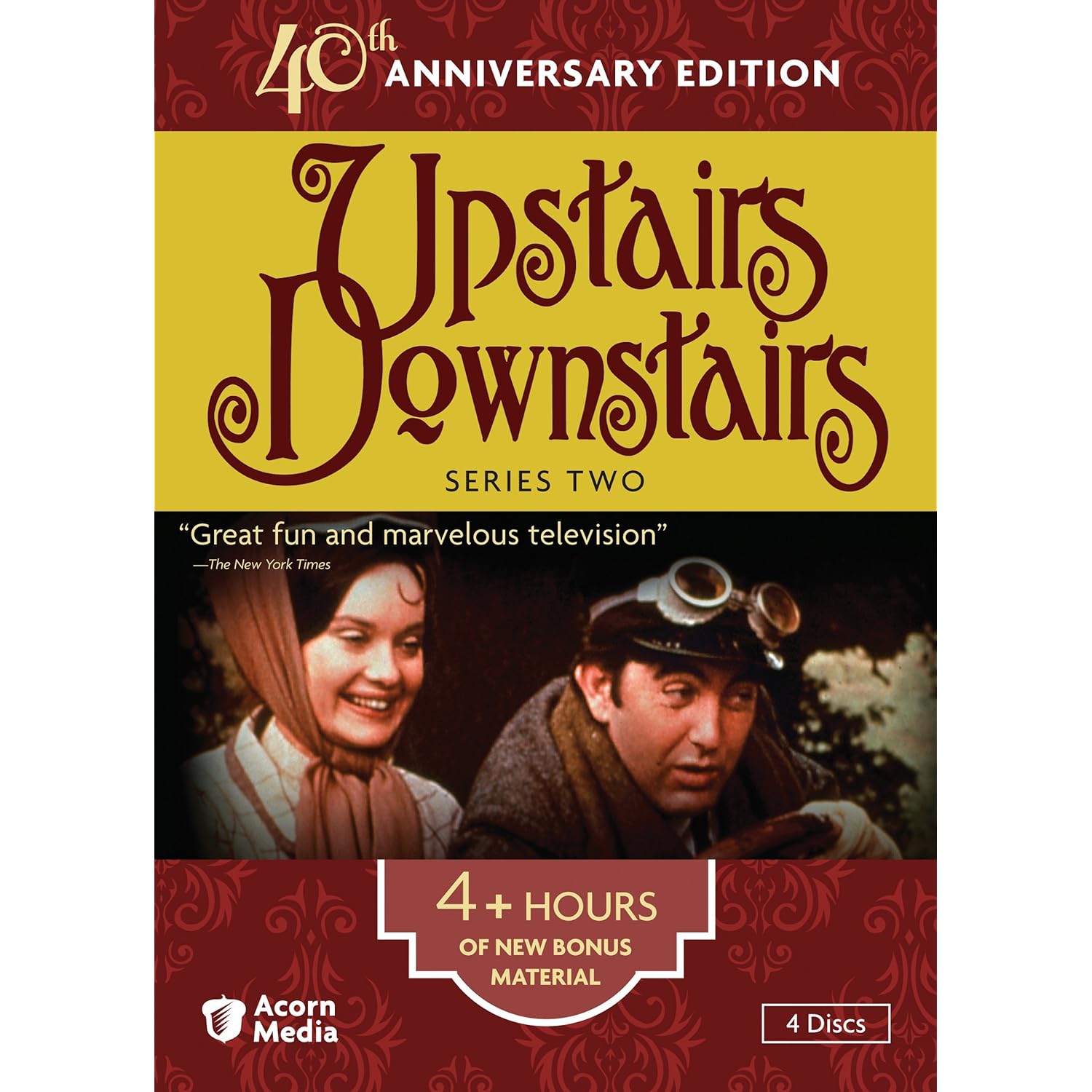
Box Art of Series 2
Synopsis
The series Upstairs, Downstairs continues after the marriage of Elizabeth Bellamy and Lawrence Kirbridge, whose marriage has started rocky. Sarah and Captain James Bellamy see each other more seriously. And downstairs, new servants have arrived: Edward the new footman, and Ruby the new kitchen maid.

Characters
The cast from the previous series returns for another series of Upstairs, Downstairs. What I found interesting was that the actor that plays chauffeur Thomas Watkins (John Alderton) was also in Little Dorrit (2008) as Mr. Casby and that he is also married to the actress who plays occasional maid Sarah (Pauline Collins).

Elizabeth Kirbridge (nee Bellamy) is still fairly irritating. She isn't a very sympathetic character even though she does have troubles. She comes off as being too much of a baby at times: she'll sometimes yell at upperhouse parlor maid Rose even though Rose hasn't done anything. She also develops some more scandalous behavior as the series goes on. I felt sorry for Richard Bellamy and Lady Marjorie: they tried to control their daughter, but she just wouldn't be controlled.

Sarah, the under house parlor maid, returns in this series. I really didn't like her for the first series and for a good deal of the second series I didn't care for her much. She was very scandalous and wanted to start a fight whenever someone told her not to do something. She was still scandalous in this series and got herself involved with Captain James Bellamy, Richard and Lady Marjorie's son. She gets a little better as the series goes on, but I still wasn't very fond of her.
Mrs. Bridges cooking. Thomas and Rose look on.

Since the start of Series 1, there had been some changes to the staff of 165 Eaton Place. Emily, the kitchen maid, had been replaced by new kitchen maid, Ruby. Alfred, the creepy footman, had been replaced by Edward, a bit of a girl-crazy footman. Even though Edward is a little girl-crazy, he isn't a bad character. He likes to joke a lot, but overall he is likable. Ruby takes a little bit of getting used to, though. Mid-Series, we see the addition of Thomas Watkins, the new chauffeur who once worked for the Kirbridges. He was mostly likable for the first part of the series, but once he came to 165 Eaton Place and got involved with Sarah he got fairly dislikable.

Scenery
Mr. and Mrs. Kirbridge at a party.
Most of the scenes were still at 165 Eaton Place, the home of Richard and Lady Marjorie Bellamy. We do get a glimpse of the Kirbridge's new home after they are married, but it is not as nice as 165 Eaton Place. Scenes from the Kirbridge's new home do not last long, however. But we do see scenes from the Bellamy's garage where Thomas works.

Costuming
The costuming still had Edwardian fashions and hadn't changed very much since Series 1. The costumes were still nice, though.

Overall: 3/5
Well, Series 2 picks up a little quicker than Series 1 and is better than Series 1, but it still can't compare to Downton Abbey. The plot of Upstairs, Downstairs is still a little slow, but it's not entirely bad. There is some content in this series: again, nothing is horribly graphic, but there are still some mature scenes. The content almost borders on TV-14... almost. Like Series 1, you may want to view this series of Upstairs Downstairs first before showing it to a young audience (like preteen or young teenagers).

Upstairs Downstairs: Series 2 is available on DVD on its own or as apart of the Complete Collection. It has 13 hour long episodes.

Monday, March 5, 2012

Review: Upstairs, Downstairs - Series 1 (1971)

As many of you may know, I'm a fan of Downton Abbey. I have often heard it compared to Upstairs, Downstairs, and though I had never seen Upstairs, Downstairs before, I knew a little about what it was about and went with the analogy. I finally got to watch the original Upstairs, Downstairs recently (after finishing Downton Abbey: Series 2). Here is what I thought.

Synopsis
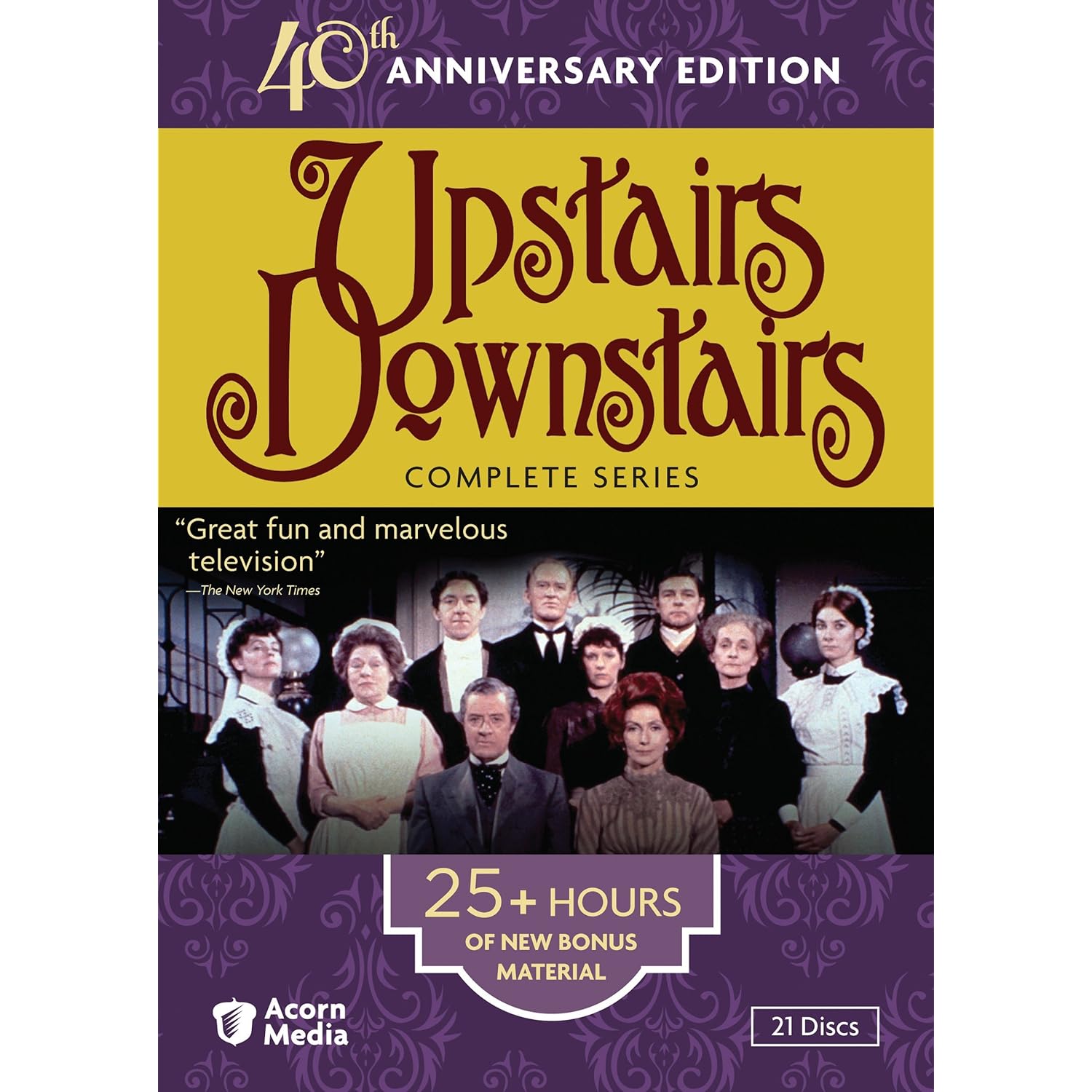
Complete Series Box
165 Eaton Place is home to not only the rich Bellamys who are involved in politics, but also to the servants who serve them. Upstairs, Richard Bellamy, a M.P., lives at 165 Eaton Place with his wife, Lady Marjorie, and when they are home, his son James and his daughter Elizabeth. Below stairs, there are many servants who keep the Bellamys' home running: the butler, Mr. Hudson, makes sure that the servants behave themselves, Mrs. Bridges cooks all the meals that are enjoyed both by the Bellamys and the servants, and Rose the head parlor maid that is also friend's with Elizabeth Bellamy.

Characters
There are a couple of the cast members that you may have seen in other period dramas. The maid Rose is played by Jean Marsh, who not only created this series and The House of Eliott with Eileen Atkins (who was also in Cranford), was also in the 2008 miniseries of Sense and Sensibility as Mrs. Ferrars. John Rapley, who played a tradesman in one episode, was in The Duchess of Duke Street as Mr. Leyton. Other than those two, I didn't recognize anyone else.

There are a mixed bag of characters in Upstairs, Downstairs. There is probably an even number of characters you like and characters you don't like: this applies to both the upstairs characters and the downstairs characters.

Lady Marjorie
Upstairs, there are characters that I personally liked. Richard Bellamy is a respectable, honorable character who I don't have much to say against. For the most part, I liked Lady Marjorie, though there was one episode she made a very bad mistake. As for James and Elizabeth Bellamy, I don't particularly care for either one of them. James is a scandalous character -- a scoundrel if you will. I find it hard to like scoundrels. Elizabeth is extremely political and radical to the point where it gets irritating. She wasn't nearly as bad towards the beginning of the series -- at that point in the beginning, she was young and didn't seem as extremely political--, but when she met some new friends, she changed for the worst. I don't foresee either James Bellamy or Elizabeth Bellamy going away or changing for the better for a long while.

Dowstairs, as it was for upstairs, there are characters that I liked and didn't like. The difference between upstairs and downstairs is that the staff downstairs changes a little throughout the series. The two characters that I found dislikable leave at some point in the series, though one comes back. Honestly, I was a little disappointed in the staff of 165 Eaton Place. Warning: I'm going to make a Downton Abbey comparison now. It seemed to me that a number of the things that went on with the staff would not have even been attempted at Downton Abbey, which seemed more orderly. In one episode, Mr. Hudson and the Bellamys leaves and the staff is running amok in the house and trying on their employers' clothes and indulging in their employers' wine! Could anyone even imagine that going on at Downton Abbey even if Mr. Carson (Downton Abbey butler) or Mrs. Hughes (Downton Abbey Housekeeper) were away? In short, it seems to me that Mr. Hudson, though he is a likable character and does maintain some control over the staff, could be maintaining more control over his staff.

Scenery
An example of the Black and White episodes
For most 70s shows, the scenery isn't much to really speak of since most series at the time were done on sets. I will say that the setting of Upstairs, Downstairs was still very nice, though it was most likely filmed on a set. However, a number of the episodes in the first series were in black and white due to labor strikes. I think by the 7th episode in the series, the episodes are all in color, but before then there were only two episodes that were filmed in color (the pilot was filmed in color and another episode was also filmed in color, but then it went back to black and white for one episode).

Uggh! I hate that hat!
Costuming
The costuming was also nice! Since the story takes place between 1903-1909, the ladies dresses were from the Edwardian era. A lot of the dresses and hats were very nice. The maids wear their usual uniforms with the exception of the scullery maids, who wore different uniforms than the other maids. I did take issue with Elizabeth's "new" wardrobe towards the end of the first series. There was one particular hat that I took a quick dislike to (it's pictured here). It was too masculine to be a lady's hat. I question if she just took one of her father's or brother's hats and decided to wear it for who knows why. But other than that, the costumes are very nice to look at.

Overall: 3/5
Upstairs, Downstairs is okay... I guess. Honestly, if you had to pick between seeing Downton Abbey and Upstairs, Downstairs, definitely go for Downton Abbey. All of the characters in Downton Abbey seemed more dignified than the characters in Upstairs, Downstairs. Don't get me wrong, there are some likable characters in Upstairs, Downstairs, but there were times where there were some behaviors going on that no one would have gotten away at Downton (Really, could anyone see Anna trying on Lady Mary clothes?). I did like Upstairs, Downstairs enough to continue watching it. Who knows, I might grow to like it a little more.

Content-wise, there aren't any graphic scenes in Upstairs, Downstairs, but there are some scenes that contain some mature themes. There are also some implications and scandals that may be a little mature. Also, especially in later episodes, there are some discussions talked about that wouldn't have been mentioned in polite conversation. But again, there's nothing overtly graphic. I also saw that on Netflix, it has been rated TV-PG, which considering today's current TV shows, wouldn't be inaccurate. I would recommend watching it ahead of time if you plan on showing this to, let's say, a preteen audience, for the themes presented and decide for yourself if you want to show it.

Upstairs, Downstairs: Series 1 is available on DVD either by itself or apart of the complete collection. You can also watch it on Netflix Instant Streaming. There are 13 episodes in the first series which are about 50 minutes long.

Tuesday, February 14, 2012

Review: Downton Abbey - Series 2 (2011)

YES! AT LONG LAST! Finally, Downton Abbey - Series 2! I had been waiting for this for months! All the cliffhangers you left, Series 1, finally will be resolved, right?! Right?! My mom and I started to watch Series 2 on Masterpiece Theater, but we missed the beginning half of the first episode. We got the DVD last Monday (which came out before the series ended on Masterpiece, hence why I can review the entire series). We just finished Series 2 with the Christmas special a couple of days ago. Here is what I thought!

Note: This review will contain spoilers from Series 1. If you do not want to read about Series 1 spoilers, I suggest watching Series 1 before reading this review. Here is my review for Series 1 if you are interested.
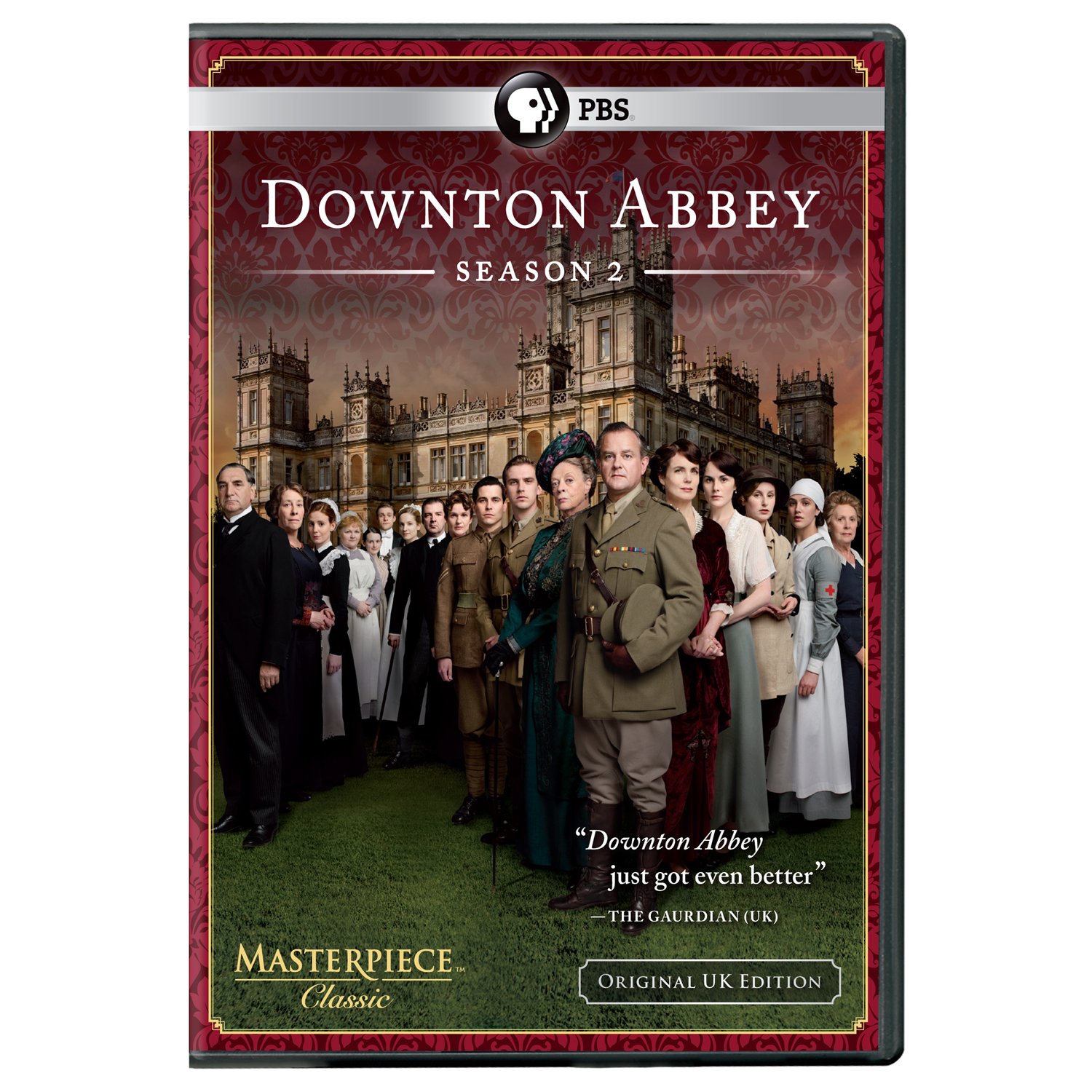
DVD Box Art

Synopsis
At the end of Series 1, Lord Grantham announces that England is now at war with Germany -- the start of World War I. Matthew Crawley has joined in the war effort and has joined the army, having decided at the end of Series 1 that he needs to get away from Downton, leaving things unresolved with Lady Mary Crawley. The year at the start of Series 2 is 1916. The Crawleys receive word that Matthew is engaged to a Miss Lavinia Swire and is coming to Downton Abbey. Meanwhile, Mary is still in love with Matthew. There are many plots in Downton Abbey: Series 2, both with the Crawleys upstairs and the staff downstairs.

Characters
Most of the regular cast has returned for Series 2 that were in Series 1. Many of the cast members you may recognize from other period dramas. At the end of this review, I have a list of the actors/actresses that you may recognize from other period dramas. One member of the main cast has not returned for Series 2: Gwen, the maid who wanted to become a secretary, has secured a job as a secretary and has been replaced by new housemaid Ethel (I personally preferred Gwen to Ethel). There is a new addition to the cast for a couple of episodes: Andrew Lang, a man who fought in WWI, has become Lord Grantham's new valet after Bates leaves for a couple of episodes. Spoiler Later in the series when Ethel is fired, another housemaid named Jane Moorsum is hired, but her employment is also short-lived. End of Spoiler We also see the addition of Sir Richard Carlisle, a rich newspaper owner who becomes a suitor for Mary.

There is a lot of character development in Series 2. WWI has changed everything in the lives of the residents of Downton Abbey. Upstairs, Sybil becomes a nurse in order to help with the war effort at home. When Downton Abbey becomes a convalescing house, Edith begins to help out with many of the wounded officers. Mary doesn't do as much until half-way through the series Spoiler when Matthew is wounded. End of Spoiler. Downstairs, William, who has recently joined the army, and Daisy become engaged: though Daisy does not love him, she is coaxed into marrying him by the cook, Mrs. Patmore. Anna and Bates face difficulties when Mrs. Bates shows up and threatens to expose Mary's scandal. And Ethel wants to better her life and doesn't want to be a housemaid forever.

Branson teaching Edith to drive a car.
In Series 1, I really didn't like Edith: she was very spiteful against Mary. In Series 2 however, she becomes much more likable. I think that it has something to do with Edith having something to do. Think about it: in Series 1, Edith didn't really have anything to set her mind to. Sybil was helping Gwen get a job as a secretary; Mary was getting to know Matthew more. What did Edith do? Not much except spread word about Mary's scandal around. Now in Series 2, she finds that she has a talent for caring for the wounded soldiers who are staying at Downton Abbey plus she learned how to drive. Once she was given a "purpose", she focused on that and became nicer. The hostilities between her and Mary break down much more, though they probably aren't going to become best friends in any future series.

Isobel Crawley trying to run Downton Abbey
Isobel Crawley, Matthew's mother, became a little dislikable during this series for a couple of episodes. She became very pushy at Downton. She was a little pushy in Series 1, but it wasn't as annoying as she was in a couple of episodes in Series 2. When Downton Abbey was turned into a convalescing house, Isobel started to take over and "push" Cora out of her position as lady of the house. I understand why Cora was upset: it was her home! Isobel was also throwing in Cora's face that she had nursing experience and Cora didn't, so she should be in charge of Downton. Good thing Cora stood her ground. By the end of the series, when Downton was no longer a convalescing house, Isobel was toned down again.

So, Lavinia... I'm not quite sure what to make of her. I don't hate her, but I don't like her a lot either. Maybe it's because I want Mary and Matthew to get married, but I'm still not sure about Lavinia as a character... She wasn't a bad character, but I'm not really fond of her either. Looking at Masterpiece's Character voting page, most people don't really know what to make of Lavinia either. She was on the "Love" side of the scale for one episode, but right next to the middle line, but for the most part, she is right on the middle line: not on the "loathe" side or the "love" side.

Scenery
Still lovely! Though there were some scenes that took place in the trenches during the battles of WWI (which were gritty), the scenes that took place at Downton were still lovely! The camera filter they used while filming this season of Downton Abbey seems to make everything look more washed out than the previous season. It works because of the serious time that everyone was going through with the war. Colorful scenes are not tossed out all together, however, and you do see some colorful scenes.

Mary and Matthew sing at a concert.
Music
Still awesome! There are some new pieces that are used in Series 2 that weren't in Series 1, which are very good. Also, in one episode, we hear Mary and Matthew sing (though I think Matthew had the better voice). A couple of months ago, the Downton Abbey soundtrack was released that has songs from both Series 1 and 2, plus a couple of vocal songs. I've just gotten the soundtrack, but even just from watching the series, the music is great.

Costumes
Sybil in her nurse's uniform. Branson is speaking to her
at work.
The costumers of Downton Abbey have done it again! On the DVD, there is one of the special features that talks about costuming. One of the things that it said was that jewelry was much more simpler than it was before the war, which would make sense since most of the money people had would go to the war effort. But I digress. There were a number of very nice costumes, though I think the costumes from Series 1 were better (though the costuming for Series 2 is very, very good). Costumes range from 1916 to really 1919 (The Christmas episode ends on New Years Day of 1920). The skirts for the dresses become a little shorter, but not like the skirts of the 1920s (we'll probably see those next season). A lot of the dresses are very ornate (though not as ornate as Series 1), but they become simpler towards the end of the series. Many of the men are also in uniforms. The special feature on the DVD talks about how the costumers paid very close attention to the medals that were on the men's uniforms, making sure they are period accurate and in the right order. Also making an addition to the costuming are nurses uniforms, mainly worn by Sybil. Nurses uniforms are worn by other nurses, but Sybil is the only member of the main cast that wears a nurse's uniform.

Cliffhangers
Matthew with Lavinia when they are newly engaged.
I created this section because, as you may know, Series 1 ended with so many cliffhangers. At the end of Series 1, almost nothing is resolved upon: Matthew and Mary's future is in jeopardy, Branson (the chauffer) and Sybil might have a future, but it's not certain that Sybil likes him enough, O'brien, Cora's lady's maid, has massive guilt (which is rightly deserved), and who knows what will happen with Anna and Mr. Bates! By the end of Series 2, most of those cliffhangers from Series 1 are for the most part resolved... Mostly... Series 2 did a better job at resolving those cliffhangers: though there are some cliffhangers that exist, the still existing cliffhangers are not as horribly open as they were from Series 1, but they're open enough that you still want to watch Series 3. I won't say exactly how each of the cliffhangers are resolved, but just know that there is some resolution at the end of the Christmas episode.

Overall: 4/5
Downton Abbey External
Why must I wait a year for Series 3? Why? Probably between Series 1 and Series 2, Series 1 was probably better (but then the first series in period dramas are usually the best). But I still really liked Series 2. Unlike a couple of other series that I have watched, I don't detect a downfall of Downton Abbey in the second series. I have a good feeling that there will be at least a couple more series (unless Series 3 is a disappointment *hoping that it's not*). Series 2 did not end with nearly so many cliffhangers as Series 1 (all the cliffhangers at the end of Series 1 were just cruel!), but it's open enough that you want to watch Series 3.

Content-wise, Downton Abbey: Series 2 has a couple of scenes that you may wish to skip, but nothing is extremely bad. There are some WWI battle scenes and some hospital scenes, one of which includes a biological conversation. There is a very brief scene in Episode 4, but if you pay attention, you can see it coming and it doesn't last long. There are a couple of implications throughout and in Episode 8, a scene happens that could have been bad, but nothing happened (plus to me, the scene was a bit implausible). Also in Episode 8, there is a scene Spoiler after Anna and Mr. Bates get married End Spoiler that you may wish to skip, but it's not very long. There is also a scene in the Christmas episode, but looking at the clues, you can figure out when it's coming (and you don't see anything). Again, there's nothing too severe content-wise, but just some things to keep in mind.

Overall, I would recommend Downton Abbey: Series 2.

Downton Abbey: Series 2 is now available on DVD and Blu-Ray. Series 2 is made up of 8 episodes, plus a Christmas episode. The first and last episodes are 67 minutes long, and the rest are 53 minutes. The Christmas episode seemed longer than most of the episodes, but I don't know for sure how long it is.


Recognizable Actors/Actresses
Actor -- Role in Downton Abbey -- Other Period Dramas

Hugh Bonneville -- Robert Crawley -- Mr. Grandcourt from Daniel Deronda
Michelle Dockery -- Lady Mary -- Ermina Whyte from Return to Cranford
Maggie Smith -- Violet, Dowager Countess of Grantham -- Lady Gresham from Becoming Jane and Betsey Trotwood from David Copperfield (1999)*
Jim Carter -- Mr. Carson -- Captain Brown from Cranford
Brendan Coyle -- John Bates -- Robert Timmins from Lark Rise to Candleford and Nicholas Higgins from North and South*
Dan Stevens -- Matthew Crawley -- Edward Ferrars from Sense and Sensibility (2008)* 
Penelope Wilton -- Isobel Crawley -- Mrs. Hamley from Wives and Daughters
Samantha Bond -- Lady Rosamund Painswick -- Mrs. Weston in Emma (1996)
Iain Glen -- Sir Richard Carlisle -- Adam Bede in Adam Bede, Mr. Preston in Wives and Daughters
Maria Doyle Kennedy -- Mrs. Vera Bates -- Titanic (2012)
Robert Bathurst -- Sir Antony Strallan -- Mr. Weston in Emma (2009)*

*Only in the Christmas Episode
Monday, February 6, 2012

Review: The Duchess of Duke Street - Series 2

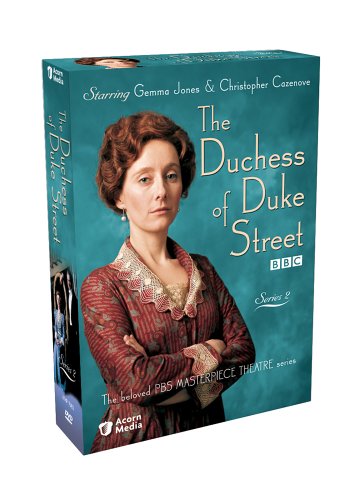
Not long ago, you may have seen that I reviewed Series 1 of this series. My mom and I finally finished the series and we were both a little sad that it ended. We just got the know all of the characters: they've almost become family. But alas! it is finished! Here is my review of it.

Note: This review contains spoilers from Series 1. If you do not want to encounter Series 1 Spoilers, I suggest waiting to read this review until after you've seen Series 1. In the meantime, here is my review for Series 1!
 

Synopsis
The story of Louisa Trotter continues where Series 1 left off. The Bentinck hotel has gain considerable prominence, hosting many distinguished guests. When WWI begins, Louisa does what she can to help with the war effort by turning the Bentinck into a convalescing home for soldiers.


Characters/Episode Plotlines
Couple of more actors/actresses that you might recognize, even more from Series 1. Of course, apart of the main cast is Gemma Jones (Louisa Trotter), who was also in Sense and Sensibility (1995) and Jane Eyre (1997). This series also sees the return of Joanna David as Lady Haselmere, Charlie's wife; Joanna David is well known in the period drama world for being in Pride and Prejudice (1995), Sense and Sensibility (1971), The Way We Live Now, and He Knew He Was Right. For some minor characters: Julian Fellowes (the creator of Downton Abbey) was in an episode as a student playing a joke on his professor) and Liz Smith (Lark Rise to Candleford) was in two episodes as "Nanny".

Much of the series has to do with World War I and how it affects the Bentinck. The Bentinck goes through some changes, Spoiler even enduring a bombing. End of Spoiler After a while, one can get a little tired of the war stories, as there are six episodes out of the sixteen that are about the war, but once those episodes are done, you don't hear a great deal about the war. The 20s are briefly gotten into, but the series ends in 1926. There is a wider range of eras than in Series 1, which only dealt with the Edwardian era.

Louisa is still a very likable character, though she can be strict at times. Spoiler When her daughter, Lottie, arrives at the Bentinck, she tries to make sure that Lottie is brought up as a lady, though Lottie has other plans. End of Spoiler
Charlie talking to the Major after WWI.

Charlie in in the series until about half-way through it. We see a little glimpse into his married life with Margaret, which ends in tragedy. He works through the grief and he eventually joins the army to fight in World War I, Spoiler but he returns, Charlie has suffered wounds from the battlefield and eventually succumbs to them. End of Spoiler With the exit of Charlie comes the entrance of Lottie. Between the two, Charlie was much more likable! Lottie was too rebellious and she was very rude to Louisa. I couldn't really identify with her very much.


Scenery
The scenery hasn't changed much from Series 1. Most of the scenes still take place inside the Bentinck, though there is an episode where you see a little garden area for the guests to sit in. There are some more outdoor scenes than in the first series. The show, as in Series 1, still looks like it was filmed in the 70s, which is to be expected since it was filmed in the 70s. But overall, the scenery isn't bad.


Costumes
Mr. Leyton, Louisa's father, visits her at the Bentinck.
This series, since it takes place over 16 years compared to the first season's 9, sees a wider range of costumes. The series starts off with Edwardian fashions, but ends with 20s fashions. Once WWI started, Louisa's usually fancy outfits became plainer and after the war ended, her clothes didn't look as nice as they once did. Her clothes made her look older (though she probably was older, but her face really didn't how it). Lottie did have some nice 20s clothes, but I don't particularly like that she bobbed her hair (but then again it was popular at that time). Personally, I preferred the costumes from the first series.


Overall: 4/5
Still a very good show, but between the two series, I preferred Series 1 (though both series got the same rating here). This series features some topics that were not spoken of as openly in series 1, but the show still maintains a PG rating (at least PG to me). There is a scene in the fifth episode that you may wish to skip, so be careful about that. I was sad that the show ended, but it was probably best that it ended when it did. 

The Duchess of Duke Street: Series 2 is available on DVD on it's own or in the complete collection. Is has sixteen, 1 hour long episodes.

Monday, November 28, 2011

Review: The Grand - Complete Collection

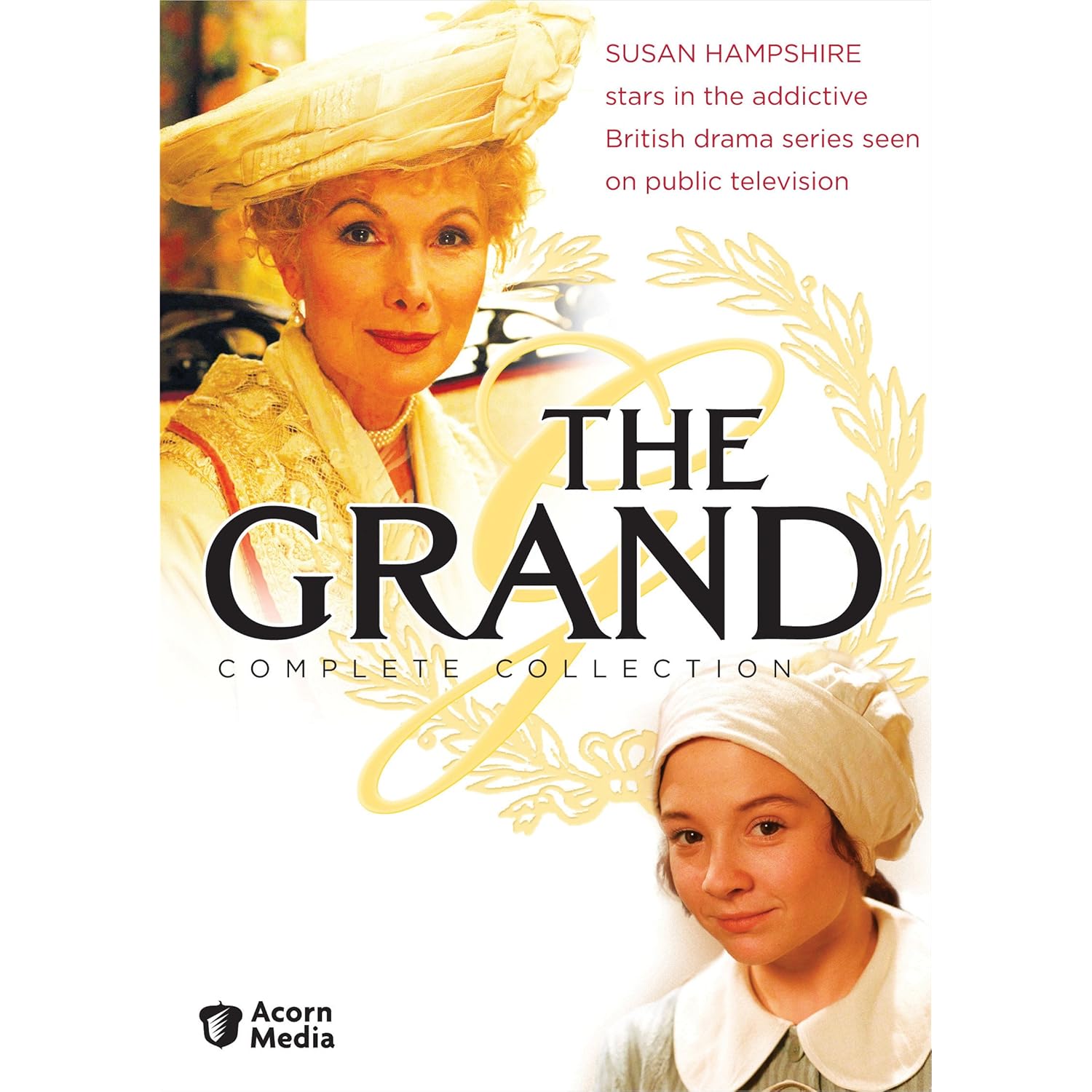
I had never heard of The Grand until my mom bought it one day on Amazon. Both of us did not know anything about the series other than it was about a hotel. As we watched the series, the basis of the story was pretty much Upstairs, Downstairs in that half the show is about the upper class and the other half is about the lower class.

Note: I would usually do separate reviews for the different seasons, but for this, I'm combining them into one review.
Complete Collection Box Art

Synopsis
After World War I, the Grand Hotel in Manchester is reopened by the Bannerman family who has owned the hotel for many years before. The plot lines of the episodes would be similar to Upstairs Downstairs in that part of the plotlines involve the patrons of the hotel and the Bannerman family and the other part involves the waitstaff of the hotel.

Characters
There was only one member of the regular cast that I recognized, and it was Susan Hampshire as Miss Harkness, a guest at the Grand.

Out of all the characters, I would say that there are only three that were likable. The three were John Bannerman, the owner of the hotel, Kate Morris, the servant girl, and Mr. Collins, the head porter. John Bannerman was the owner trying to make the hotel successful after being closed for so long; he loves his family, but sometimes can't express it as well as he should. Kate Morris, the servant girl, tries to do her job and follow the rules; she cares for her friend, Monica, and tries to keep her out of trouble (which didn't work out). Mr. Collins lives with the grief that his son was executed for abandoning his post in the military, but he copes with it and runs the hotel well.

Kate Morris and Stephen Bannerman, John and Sarah Bannerman's
son.
The rest of the characters were horribly, horribly flawed. Miss Harkness has a very disreputable past and for the first half of the first series is proud of it and talks about it openly (Susan Hampshire, you could have done a lot better). She does seem to regret her choices, but ultimately goes back to her previous lifestyle. Marcus Bannerman, John Bannerman's brother, is just creepy and slimy. Sarah Bannerman, John's wife, begins to move away from her husband towards the creepy Marcus. Marcus's girlfriend (later fiancee and then wife) Ruth is mistreated by Marcus the whole first series, though he is slightly better to her face during the second series, but still neglects her. Need I go much further? And that was only part of the upstairs plotlines. And a bit more goes on with the servants that work downstairs. If you're looking for role models, don't look for them in The Grand.

There were also a lot of topics that wouldn't have been discussed so openly in company at the time. Realistically, during that time, there were certain subjects that would have been much more discreetly discussed if discussed at all. In The Grand, those subjects were talked about as if it was a modern day soap opera! It was quite unnecessary and inaccurate.

Scenery
Miss Harkness and Kate Morris
The Grand Hotel itself is something to look at! It's has many lovely views and always looks clean. There aren't many scenes that take place outside, so a great deal of the scenes are inside the hotel.

Costumes
Some of the costumes were well done. A good deal of the guests/owners costumes were very nice and looked pretty. The servants' outfits were the same uniform that they wore. However, it seemed like during the second season, however, that the costumer for The Grand was going out of their way to make Miss Harkness's dresses extremely immodest; it was extremely ridiculous and unnecessary.

Music
The theme music was very nice. It's very flowing and can get stuck in your head easily. Other than that, there aren't many songs that stood out to me very much.

Overall: 0.5/5
I WOULD NOT recommend this, especially to families. There are a lot of scenes that are very mature and a lot of the topics discussed during the show were inappropriate and wouldn't have been talked about so openly during the time period. Honestly, The Grand was more like a modern day soap opera with everyone's dirty laundry out for everyone to see in period fashions. I can't even say that you can easily skip past the inappropriate scenes: some can take you by surprise. I usually don't like to quote other reviewers on my reviews since my reviews are mine, but one reviewer at IMDB put it accurately when they said, "The Grand is just too sordid for more than one viewing." So I won't be watching this again. Be warned about this series. Though the costuming is nice and the hotel itself is lovely to look at, there is some very mature content present throughout the entire series that ruins the entire experience. And, honestly, the plotlines weren't that great to begin with.

The Grand is available on DVD. It is made up of two seasons and 18 episodes that are about 55 minutes long.

Monday, August 29, 2011

Review: Pride and Prejudice (1980)

Couple of things before you read this review: 1. I am a bit biased for this review since I not only have seen the 1995 miniseries of Pride and Prejudice, but I absolutely love it and it's one of my favorite things to watch. 2. I'm not much of a fan of the older BBC period dramas (though there are some that I absolutely love *cough* Barchester Chronicles *cough*). So as you read my review, you may or may not agree with me. But this is my opinion of this version of Pride and Prejudice.


Box Art

Synopsis - Taken from Pride and Prejudice (1995) Review
Mrs. Bennet is trying to marry off her five daughters. When the rich Mr. Bingley moves into the neighborhood, Mrs. Bennet is determined that he marry one of her daughters. Mr. Bingley takes an interest in Jane, the eldest daughter, while his friend, Mr. Darcy, offends Elizabeth, Jane's sister.


Characters
I only recognized two members of the cast. Elizabeth Garvie (Elizabeth Bennet) I have seen in the second season of The House of Eliott as Lady Elizabeth Montford (Does she tend of have characters with the name Elizabeth a lot?). I also saw that Judy Parfitt (Lady Catherine de Bourgh) was in here: I have seen in Little Dorrit as Mrs. Clennam.


Elizabeth (Elizabeth Garvie) with Jane (Sabrina Franklyn)
Most of the characters I was severely disappointed in. (Forgive me, but I'm going to have to make some comparisons here). Sabrina Franklyn's Jane Bennet was pretty, but I thought that she just wasn't Jane; I pictured Jane as being much more quiet/gentler in her manners and way of speaking. Elizabeth Garvie's Elizabeth just isn't Elizabeth, but more on Elizabeth Garvie's Elizabeth later. Mary Bennet was portrayed as being much too silly: they made her more like Kitty and Lydia, especially at the beginning (honestly, did Mary really care that Mr. Bingley was renting Netherfield Park like everyone else?). Kitty seemed like she was either coughing or crying the entire time (plus when Mr. Bingley returned, suddenly Mrs. Bennet wanted him to marry Kitty?!), but Lydia does exhibit her usually annoying character (though I think Julia Sawalha was more entertaining to watch in the 1995 miniseries). Mr. Bennet seems to be much more malicious than he is supposed to be: he always sounded annoyed at everyone and the lines that were supposed to be said in a light way were said quite angrily. Mrs. Bennet was annoying, which she should be, but she lacked the over dramatic personality that Alison Steadman was a much better in portraying in the 1995 miniseries. I will say that I did like Irene Richard's Charlotte Lucas, though everyone remarked on how she was plain, but I didn't think she was that plain, but even her character wasn't as accurate as it should have been. A lot was added when Elizabeth visited her and Mr. Collins at Hunsford. If you didn't like that in the 1995 miniseries that Mr. Darcy jumped in the lake for a swim, you probably won't like that Mr. Collins had an "aqua hat" and that he actually wore it to pick stuff out of a pond with Charlotte. And it seemed like if Lady Catherine said something about cleaning the house (or in this case, chairs), Charlotte would personally attend to it on her hands and knees. Would Charlotte have done something like that? I don't believe so. Lady Catherine herself could have had a home improvement show: when you first see her, she's giving all this housekeeping advice. It was much overdone.

Elizabeth Garvie is not a very good Elizabeth Bennet. She seemed to be more catty than she should have been. I've never thought of Elizabeth as catty, but rather as someone who was offended by Mr. Darcy. In this Pride and Prejudice, Elizabeth seemed to be actually in love with Wickham for a while and everyone seemed to know about it and she seemed to express it pretty obviously, which isn't supposed to be. Also, the way that she delivered some of her lines at some serious moments was almost done comically. If she wasn't comical in the delivery of her lines, she was quite dull. Honestly, Elizabeth Garvie's Elizabeth can't even compare to Jennifer Ehle's Elizabeth in the 1995 miniseries. Jennifer Ehle had a way of speaking Elizabeth's lines that was very easy and natural to her -- and it came out very natural and sounded like the Elizabeth in the book. Elizabeth Garvie seemed to not only say her lines in a way that was quite dull, but she also made Elizabeth look more catty than she should have been.


Mr. Darcy (David Rintoul) proposing to
Elizabeth (Elizabeth Garvie)

Let me say this: David Rintoul is not Mr. Darcy. All his lines were said very, very dully and with absolutely no emotion. It seemed like the whole time, he was just spitting out his lines as quickly as possible. Even when Elizabeth ran to Pemberly to tell him about Lydia's elopement (which is definitely not the way it happened in the book), he failed to be at all affected by Elizabeth crying in front of him. It seemed like he was merely speaking the lines and not acting them. He barely moved as he was talking, resembling a block of wood. Spoiler I'm also not one for romantic scenes much, but could Mr. Darcy's second proposal possibly be any duller? There seemed like there was absolutely no emotion in the entire scene (I know the emotion is not supposed to be excessive, but it ought to have been subtle. It was just entirely lacking here). Again, it's another example of both Elizabeth Garvie and David Rintoul just saying the lines and not acting as Elizabeth and Mr. Darcy. End of Spoiler I think I am much more far assured that Colin Firth is the definitive Mr. Darcy.


Scenery
You can't really expect very breathtaking scenery from a BBC miniseries made in the 70s or 80s. The outdoor scenes were okay, but nothing special. The miniseries does come off like a play (as do many period dramas of the 70s and 80s). Comparing to other period dramas from the 80s, I would say the quality is about the same.


Wickham telling Elizabeth how Mr. Darcy
wronged him.


Costumes
The costuming was okay. Everything looked for the most part period accurate. I notice that many of the women wore chemisettes under their dresses, which would be accurate to the time period. A lot of lace in the necklines for evening wear was used, though, which is something that I've never noticed before. I don't have any reason to say that it's inaccurate, but I haven't seen it before and I've seen quite a bit of movies that take place in the Regency Era.


Music
Not the best music. I wouldn't say that the background music is representative of the music of the time. And the Mr. Collins theme was horrid! It sounded like a song out of some really bad comedy. A little bit of a side note: I noticed that Mary Bennet would always sing the song "Early One Morning". I instantly recognized the song since I am a fan of the show Bonanza, and that was a song most notably sung by the character Adam Cartwright. (By the way, Adam sung it much better)


Overall: 1.5/5
There are a lot of people who really love this version of Pride and Prejudice: I'm not one of them. There were just so many elements of the story changed and many of the characters were not the way that they should have been. This miniseries was much more duller than it should have been. I would definitely say that if you only want to see one version of Pride and Prejudice, skip this version and watch the 1995 one: it's much more accurate to the book and a lot more fun to watch.

Pride and Prejudice is available on DVD and VHS and is also on Netflix Instant Streaming. It runs for 265 minutes and is made up of five episodes.

Monday, July 25, 2011

Review: Persuasion (2007)

I watched this version of Persuasion a while ago: half on Youtube, half on Masterpiece Classic (which was shortened and edited). When I first watched it the whole way through, it really didn't make too much of an impression on me. But recently, I re-watched it and have formed a better opinion of it. I guess I noticed more than when I first saw it. I had also recently finished reading Persuasion: it wasn't my favorite Jane Austen book, but I still liked it.
Box Art

Synopsis
Eight years ago, Anne Elliot was proposed to by Frederick Wentworth, a poor man who joined the navy, and accepted his proposal but was persuaded by her godmother, Lady Russell, to break off the engagement since Anne would be taking a big risk marrying him. Now twenty-seven and still unmarried, Anne assumes to be an old maid. When Captain Wentworth comes back into her life, having made his fortune in the navy and now looking for a wife, he is very cold to her and she thinks that he cannot forgive her for what she had done eight years ago.

Characters
Couple of members of the cast I recognized in here. Most notably:  Stella Gonet (Mrs. Musgrove) was Bea Eliott in The House of Eliott, Peter Wight (Admiral Croft) was also in a couple of episodes of Lark Rise to Candleford. I also know that Rupert Penry-Jones (Captain Wentworth) was also in the 1997 adaptation of Jane Eyre, but I had only seen clips of it.

Sally Hawkins as Anne Eliott
Sally Hawkins was absolutely lovely as Anne! I think she really captured Anne's meekness and quietness very well. In Persuasion (the book), a good part of it is what Anne is thinking or feeling: there can be pages of her thoughts and emotions. To illustrate this, the film-makers had Anne keep a journal to write down her feelings, some of which was spoken through a voice-over of Anne. In this case, I think it really worked to do that: they included that part of Persuasion which could be difficult to include and it was done fairly well. Spoiler What I didn't care for was Anne's marathon through Bath at the end. It wasn't at all like the book. She ran out of Camden Place (without a bonnet, by the way), met Mrs. Smith (who should be crippled, yet she was walking; and did anyone else find it kind of funny that her name is Harriet Smith? Any Emma fans out there?) to find out that Mr. Eliott isn't honorable (and added something that included Mrs. Clay that wasn't in the book, at least to my memory), ran to the Croft's residence to find that they had left and Captain Harville gives her Captain Wentworth's famous note, runs to find the Crofts and discovers that Captain Wentworth had just left them, to which she runs a great distance and happens to bump into Charles Musgrove, her brother-in-law, and Captain Wentworth. (Woo... That was confusing). It seemed to be unnecessary to add this whole running escapade; could anyone help thinking "Run, Anne, run!"? End of Spoiler But excepting that part, I think Anne was portrayed very well in here.

Rupert Penry-Jones as Captain Frederick Wentworth
Rupert Penry-Jones's Captain Wentworth... I'm not fully convinced by it, but I'm about 90% convinced. I mean, I didn't hate his Captain Wentworth, but it didn't seem quite right. To me at least, he looked too young (I know Rupert Penry-Jones was actually about 36 or 37 for the role, and Captain Wentworth is supposed to be in his early thirties): it didn't look like he had been in the navy at all. His acting, however, was pretty good. Although Captain Wentworth isn't my favorite Jane Austen hero (he seemed to be purposely trying to ignore/hurt Anne a lot of the time, which I didn't like), but I think overall Rupert Penry-Jones did justice to Captain Wentworth as far as acting goes. I still think they could have made him look more like a Captain Wentworth that had been in the navy and worked hard to get his fortune: here he only looks like he didn't have to work hard to get his fortune.

I really didn't like Anthony Head's Sir Walter. I never pictured Sir Walter as a creepy guy... Arrogant and narcissistic, yes, but not so much creepy. There was something in the way he said lines that made him a little creepy, which isn't the effect you want for Sir Walter. You want to portray him as a caricature of an arrogant narcissistic baronet, and I just don't think that effect was expressed in here. I did think that Elizabeth Elliot was portrayed well: uncaring, selfish, and trying to be fancier than she really is.

Scenery
Good scenery in here, but sometimes it can be a little bleak, especially at Lyme. I didn't care for the darker scenery at Lyme: Persuasion is one of Jane Austen's more serious novels, but I didn't picture it as dark. If they used the darker scenery at Lyme after Anne's sister-in-law, Louisa, gets hurt, it would make sense, but during the whole time? It just didn't seem to fit. The rest of the scenery was very good: the houses were very nicely furnished and there is lovely outdoor, country scenes to be seen.
Lady Dalrymple: notice the hair piece

Costumes
Great costuming! Wonderful costuming! All the dresses looked lovely! My only complaint is towards the end at the concert in Bath, Elizabeth Elliot, Mrs. Clay, and Lady Dalrymple were wearing hair pieces that didn't become popular until the 1830's; I don't think they were even worn in the Regency Era or even in the early 1820s. Other than that, everything seemed pretty accurate to the period.

Music
All the music sounded similar, but it was still very lovely. It really expressed the serious tone of the novel.


Overall: 3.75/5
Left to Right Background: Anne Elliot, Elizabeth Elliot, and
Mary Musgrove. In front: Sir Walter Elliot
Overall, I liked this version of Persuasion. It might not be exact to the book (especially at the end), but I still think that it was still a great film. Sally Hawkins was wonderful as Anne and Rupert Penry-Jones's Captain Wentworth was good. The costuming is very beautiful and a pleasure to look at. The scenery could sometimes be a little bleak, but most scenes are very nice and pretty. I enjoyed this film and wouldn't be sorry to watch it again.

Persuasion is available on DVD either with Sense and Sensibility (2008) in a special collection or on it's own. It runs for 120 minutes.

Monday, July 11, 2011

Review: Great Expectations

Box Art
I've never read Great Expectations, but I was aware of it and knew it was a classic. I noticed this film in a store once, but I kind of glanced past it. After a while, I noticed this movie on Youtube, so I thought I would give it a try on Youtube and see if I liked it or not.

Synopsis
Young Pip is invited to the home of Miss Havisham to entertain her and Estella, a orphan that she raised after her fiancee abandoned her on her wedding day. Years later, Pip comes into a great fortune from an unknown benefactor that quickly changes his life.

Characters
I only recognized three members of the cast. Though I haven't yet seen Amazing Grace (but I really want to!), I knew of Ioan Gruffudd (though I never realized it, he was also in 102 Dalmations, which I loved to watch as a kid) and he was Pip in this version of Great Expectations. Justine Waddell from Wives and Daughters was also in this adaptation as Estella. The last actor that I recognized: I saw Jaggers come onto the screen and I thought "Where have I seen him before", and it dawned on me that he was in Star Wars Episode I: The Phantom Menace (though not my favorite Star Wars movie). Other than those three, I didn't recognize anyone else in this Great Expectations.

Miss Havisham (seated) with young Estella
and young Pip
The acting overall was good. However, this was one of those movies where you like a couple of character, and the rest you either don't like too much or they just irritate you. Characters like Joe and Herbert I found to be likable, and, at first, I found Pip likable. Pip kind of got on my nerves after he got money: I thought he started to spend money irresponsibly, but this was probably the angle that Dickens was going for to prove a point; maybe Pip was similar to Mr. Dorrit in Little Dorrit -- how Mr. Dorrit got his money and started to act like a jerk to everyone from his past, only in Little Dorrit, there wasn't much of a sign that he was running out of money while he was spending it while in Great Expectations there is talk of Pip running out of money. But back to my original point, before Pip became rich, he seemed a lot more likable. Other characters, like Miss Havisham, Estella, and Mrs. Joe, I couldn't like too much. Well, maybe I felt more sorry for Estella after she got married, but before that I really didn't like her. Miss Havisham seemed to be a little "off her rocker" (for lack of a better phrase), and Mrs. Joe seemed to treat young Pip unfairly all the time.

Scenery
Since the story isn't really a happy story, you won't find much bright, colorful scenery as you would in other period dramas. Most scenes have a grayish tinge to them and, for the second half of the movie, take place in the middle of London. There are some scenes in the country, but they aren't anything spectacular.

Costumes
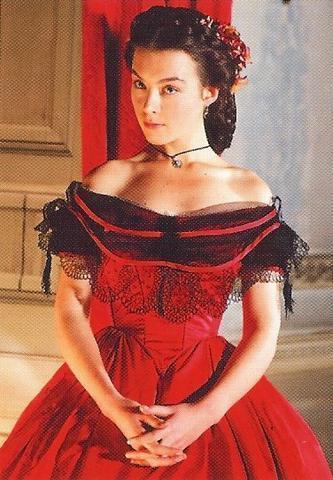
Justine Waddell as Estella
The costumes were good! Estella's dresses were very lovely to look at; they seemed to dress her in a lot of red (at least to my memory). Miss Havisham had only one dress: a Regency era wedding dress. It would make sense for her to have Regency fashion: yes, she is wealthy, but she also hasn't left her home in a very long time and she is also older.

Music
There wasn't much music to speak of. If there was a soundtrack to this miniseries, it would be composed of probably only one song: a very eerie song that seemed to pop up every once in a while. 

Overall: 2/5
I found this Great Expectations to be only tolerable. Some of the costumes were okay to look at, but not much else recommended itself to me. While the acting was good, I found a lot of the characters to be dislikable or irritating. I'm not quite sure if this version is accurate to the original story (though, from what I read on a synopsis, the ending was different), so if anyone out there has read the novel and can compare it with this adaptation, I would be thankful. Honestly, I probably wouldn't watch this version again, but maybe if a new version of Great Expectations came out (which, from what I hear, there are two in the making), I might watch it.

Great Expectations is available on DVD. It is a two part movie that runs all together for 168 minutes.

Monday, June 6, 2011

Review: Under the Greenwood Tree

I happened to be looking through Netflix to see what movies I could watch. It occurred to me that I have seen Under the Greenwood Tree mentioned on Old-Fashioned Charm. And (to my liking) I found that it was available on live streaming. So I watched it one evening.

Box Art

Synopsis
Miss Fancy Day, a young educated woman, comes to live in a village in order to care for her ailing father and becomes the teacher of the local school. Three men immediately fall in love with her and want to marry her: the rich Mr. Shiner, the poor, hard-working Dick Dewey, and the local vicar Mr. Maybold.

Characters
There are two members of the cast that I recognized. Keeley Hawes (Fancy Day) was Cynthia Kirkpatrick in Wives and Daughters (her character I found more likable in this movie), and Ben Miles (Mr. Maybold) was Sir Timothy Midwinter in the first season of Lark Rise to Candleford.

This story was a lighthearted story, so most of the plot didn't have anything too sad in it. Part of the story has to do with the church choir being replaced with a harmonia played by Fancy. This plot was funny and comical. It was one of the elements of the movie that really added a light tone to the entire story. I even found the romance of the story comical! The two characters Mr. Shiner and Mr. Maybold were so comical in their own way (Dick Dewey was the only one of the three that I took seriously Spoiler since it seemed like him and Fancy really loved each other, so I could tell they would end up together End of Spoiler).
Fancy Day in the front. In the background from left to right:
Mr. Shiner, Mr. Maybold, and Dick Dewey.

Scenery
A lot of shots were taken to a tree (hence why the title is Under the Greenwood Tree). I'm not quite sure what the significance is (if anybody would like to help me out on this, I would be grateful). But the colors are very nice and the scenery is very pleasant to look at.

Costumes
The movie take place in the 1840s, which would be before the crinoline (hoopskirt) was used. I really liked some of Fancy's dresses. The red ball gown that she had for the first party that she attended in the village was so cute!


Music
Fancy Day
The music can vary between the music played in the background, the music that is being played or sung by the characters, or the dance music. All of which are lovely! The music that is sung is mostly by the choir and includes Christmas carols and church music. The choir had a lovely sound to it! The music that was played by the instruments was also very nice, and the dance songs were good too!

Overall: 4/5
I really enjoyed this movie. It was light-hearted and entertaining, perfect for an evening at home. This isn't a story that would bring you down from a happy mood, but rather would make you feel better after a bad day. I was amused throughout the entire movie and I wouldn't be sorry to watch it again!

Under the Greenwood Tree is available on DVD and is about an hour and a half long.

Monday, May 30, 2011

Review: Emma (1997)

This was the first version of Emma that I saw. It was on Masterpiece: Classic one weekend a couple of years ago, so my mom and I sat down to watch it.
Poster/Box Art

Synopsis
Synopsis taken from Emma (2009) Review
"Emma Woodhouse, handsome, clever, and rich" is a woman living in the English town of Highbury with her father. After making a match that lead to the marriage of her governness, Miss Taylor, and Mr. Weston, Emma (Kate Beckinsale) had fancied herself to have a knack for matchmaking. She is determined to make a match between Mr. Elton, the local vicar, and Harriet Smith (Samantha Morton), much to the chagrin of her father and her brother-in-law, Mr. Knightly (Mark Strong).

Characters
Both Kate Beckinsale and Mark Strong are fairly well known, but you might recognize some of the cast in Emma. Samantha Bond (Mrs. Weston) was in one episode of Downton Abbey and Lark Rise to Candleford and was also in Mansfield Park (1983). Samantha Morton (Harriet Smith) was in Jane Eyre (1997). Olivia Williams (Jane Fairfax) was also in Miss Austen Regrets. Lucy Robinson (Mrs. Elton) was also in Pride and Prejudice (1995). And I believe Raymond Coulthard (Frank Churchill) was also in He Knew He Was Right.
Emma Woodhouse with Frank Churchill (Left)
and Mr. Knightley (Right)

Kate Beckinsale was okay as Emma (though not my favorite as Emma and even though I thought her imaginings were getting to be too much), but to me, Mark Strong is not Mr. Knightley. He seemed to be always yelling whenever he got upset, like he was going to throw a chair or something. I mean, was it really like Mr. Knightley to start yelling when he heard that Frank Churchill went to London to get his hair cut? I could see Mr. Knightley making a sarcastic remark about it, but to actually start yelling?

I didn't particularly care for Samantha Morton's Harriet. In the book, she is supposed to be a pretty looking girl, and I don't think that she was pretty enough. Olivia WIlliams's Jane Fairfax I liked. She was elegant and pretty, as she is in the book. I particularly disliked Frank Churchill in here, though. He just seemed too full of himself and he really irritated me (well, more than Frank Churchill usually does).I also thought that Miss Bates was too old. When I picture Miss Bates, I see someone in her late 30's or in her 40's; this Miss Bates could have been in her mid fifties or later.

Some of the acting I thought was forced and not "real". It just seemed like some of the lines were just said... It seemed like there were some spots where there could have been a little more emotion or if an emotion was expressed, it came out fake.
Jane Fairfax (Background) and Harriet Smith (Left Foreground)
and Emma Woodhouse (Right Foreground)

Scenery
There are some nice outdoor scenes, but I thought that some of the overtones were a little dark for Emma. Emma is a light-hearted story, so the scenes ought to be light and vivid, but the scenes were dark. Scenes take place outside either in Highbury, out on the country roads, or outside of Hartfield or Donwell Abbey, or inside the different homes of the characters.

Costumes
Some of the costumes I liked, others not so much. I never really liked the extra high neckline, so when Harriet had a white dress with a really high neckline, I didn't like that dress. I also thought that they over-did some of the neck kerchief frills: the ones without the frills were much better. The rest of the gowns, overall, I thought were good.

Harriet and Mr. Elton married?! One of Emma's many
imaginings...
Music
Some of the music is very light and bouncy (like the theme song and dance numbers), but there were times during Emma's imaginings that the music got very serious and completely unlike the tone of Emma. Overall, the music is kind of a hit and miss.

Overall: 3/5
I didn't completely hate this version of Emma, but I much prefer the 2009 miniseries to this version. The acting wasn't the best and the scenery could have been a lot lighter and more fitting to the tone that the book had. If you don't have too much time to spare and want to watch a version of Emma, this version or the Gwyneth Paltrow version are both okay, but if you really want a good sense of Emma and have the time to spare, watch the 2009 miniseries.

Emma is available on DVD. It runs for 107 minutes.

Monday, May 2, 2011

Review: Lark Rise to Candleford - Series 4

Since I first saw Lark Rise to Candleford, I fell in love with it! It was good, fairly clean family fun. Though Series 1 is still my favorite season, I continued to enjoy Lark Rise to Candleford and was glad that a fourth season was coming. However, I was sadden by the fact that Season 4 was going to be the last season and that it was only going to be six episodes (Nooooo!). Although I thought the third season wasn't the best, I still want Lark Rise to Candleford to go on...

Note: There are going to be spoilers from previous seasons in this review. If you haven't seen Lark Rise to Candleford, you might want to take a look at the previous seasons. First -- Second -- Third
Box Art

Synopsis
When Gabriel Cochrane (Richard Harrington) loses his wife, home, and factory in the same year, he goes to Candleford to find justice for the wrong that he claims the bank did against him. When postmistress Dorcas Lane (Julia Sawalha) gives him a job at the forge, the two form a friendship.

Characters
The only major cast change from Series 3 to Series 4 is Robert Timmins (Brenden Coyle) -- he did not appear in Series 4, though he is mentioned often. In the show, we find out that he is working in Oxford and sending money home to his family while Emma takes care of the house and children; in real life, Brenden Coyle started acting in new series Downton Abbey and left Lark Rise to Candleford. But back to the show. As much as Robert was getting annoying (he always seemed to be arguing with someone at any opportunity), his presence was missed in Series 4.

Ruby Pratt briefly left Candleford in Series 3... and she came back in the first episode of Series 4. During the first couple of episodes, it seemed that any character development that they made for her vanished. She became very bitter since her romance from Series 3 broke apart. She does revert back to her more developed character in Episode 3, but for the first two episodes, it seemed like she hadn't changed from Series 1 (or even went backwards from Series 1).

Laura continued to get on my nerves. She just seemes to act more and more like a know-it-all. Back in Series 1, she seemed to be more innocent and naive which worked for her, but during the middle of Series 2, she wasn't naive anymore, but instead was a know-it-all.

In the last episode, Alf's mother, Caroline (Dawn French), comes back. I guess since she was gone for so long, I didn't really miss her too much. We all got used to the idea that she was in prison a lot, so when she came back, it was like "Okay, she's back. Whatever."

Gabriel Cochrane (Richard Harrington)
The addition of Gabriel Cochrane wasn't too bad. There's a lot of conflict between him and Dorcas, some of which would be something a married couple might fight over, Spoiler so it was kind of obvious that they would end up together. End of Spoiler Dorcas seemed to be trying to impress him in later episodes (like trying to buy more feminine clothing), which didn't really seem to match Dorcas's character from previous seasons.

Scenery
The scenery continues to be excellent! You do get to see a little more of the fields than you did in previous seasons, but overall the scenery didn't change very much.

Costumes

Minnie and Dorcas at a Church festival
Still lovely! Pretty much the same type of clothing as in previous seasons: late Victorian. Everyone's style still remained the same: Dorcas was professional looking, Ruby and Pearl wore the same thing as each other and had current fashions, Laura still dressed fairly young. Minnie is seen in other dresses other than her maid's outfit, but we started to see her in other dresses last season.

Overall: 4/5
Most of the episodes were good: the exception was the third episode (it wasn't good at all). The rest were okay. I'm still sad that it ended, but at the same time, any other seasons aren't going to be like what the first (or even second) season was. Overall, I really liked the series, and I would still recommend it to anyone.

Queenie and Alf
Spoiler The last episode made a really good attempt at tying everything up at the end. Margaret is finally going to have a baby, Dorcas and Gabriel fall in love with each other and (we can assume) might be engaged or very soon will be, Caroline Arless is determined to change her ways, Queenie forsees change in the future, and Minnie and Alf are engaged. My only question is what happens between Laura and Daniel: there was a little bit of a cliffhanger there. Last we see of them, Daniel tells Laura that he cannot publish her article because it's not her and that she needs to write about her surroundings like she always does. I was kind of hoping that they would get engaged or something. Oh well! End of Spoiler

Lark Rise to Candleford - Series 4 is available on DVD. It has six, one hour long episodes.